Friday, October 17, 2014

A New "Left Behind" Movie? Why I'm Skipping This One...


I have no plans to see the new Left Behind movie, and it is not because one of my least favorite actors is the star (Nicholas Cage). No, I'm afraid I'm skipping out on this one for theological reasons.

First of all let me say, Yes! I believe Jesus is returning. Yes! I believe it is a literal, personal return. Yes! I believe that He is coming back to judge the living and the dead.

But not in the way that Left Behind popularly portrays the rapture. I think they've got it seriously wrong, at least judging by the first movie (did we really need a new one?) and the fictional book series by the same name.

Instead, I want to recommend a book on eschatology (study of the end times) that I think interprets the Bible's real view of the endtimes much better. (See review below).

It is taken for granted that pretribulational premillennialism (or dispensationalism) is gospel truth in most quarters of the evangelical world today. This, however, has not always been the case.

Pretribulational premillennialism, popularized by such fictional works as the Left Behind series and fantastical works as The Late Great Planet Earth--not to mention the Scofield Reference Bible--has quickly infiltrated the center of evangelicalism. This despite the fact that it is less than 200 years old!

Many evangelicals are not even aware that there are any "alternative" positions on the end times. That these alternatives held the majority consensus among the Puritans and Reformers is lost on most. If many today are aware of these other eschatological options at all, they have likely been taught that they are the positions held by liberals who do not "take the Bible literally."

In Kingdom Come: The Amillennial Alternative, Sam Storms destroys these preconceptions by powerfully asserting the Biblical force of the historic position that the millennial kingdom--mentioned explicitly only in Revelation 20:1-10--is symbolic of Christ's present reign in this age.

Storms begins the near 600-page work by advancing the hermeneutical principles on which he will build his case. In these early sections of this book, Storms makes clear that bald literalism is not always the best interpretive grid, especially for apocalyptic literature. Genre, literary conventions, and OT usage of language are also crucial factors when we interpret Scripture.

Using a redemptive-historical and grammatical-historical approach, Storms then wades through the most important Bible texts related to eschatology: Daniel's 70 weeks, Jesus' Olivet Discourse, 2 Thessalonians and the Antichrist, and of course, a volume of passages in Revelation.

While Storms works through these passages as a master exegete, he calmly (and without a divisive spirit I am glad to report!) shows how many of these texts have been misread through the dispensational lens, often without the critical reflection that the texts themselves demand. Storms reveals an absolute mastery of Biblical Greek, and employs this trade in the most intricate details of these Biblical passages.

Though most will doubtlessly disagree with at least a few of Storms conclusions (I doubt all readers will be convinced of his partial preterist interpretation of Matthew 24, for instance), it will be impossible to suggest any longer that amillennialism is built upon either a lesser view of the authority of Scripture in particular, or a liberal theological framework in general. No, it will no longer do to simply dismiss amillennialism (or postmillennialism for that matter) as though they do not take the Bible seriously enough.

On the contrary, the reader--who must do significant work alongside Storms with Bible and pencil in hand throughout--will see a cumulative case building for amillennialism. This is spelled out clearly and finally in the last chapter of the book where Storms gives 30 reasons that he believes pretribulational premillennialism is not Biblically defensible. Storms' amillennial construct (actually the simplest and cleanest of the four major end-times positions) holds up remarkably well when tested by the WHOLE of the New Testament rather than conditioned by one admittedly difficult and highly symbolic text (i.e. Revelation 20).

For me, the most compelling Biblical data summoned by Storms can be summed up in the following points:
  • The NT never splits up the Return of Christ (that it, His Second Coming) from the Rapture as though they were two separate events. (Dispensationalism demands this). 
  • Neither the OT nor the NT ever split up the resurrection of the dead into two events (or possibly many more!) separated by a thousand years as dispensationalism requires. 
  • The NT teaching on Jesus' parousia (Greek: return, presence, coming i.e. the Second Coming) demands the end of all sin, death, and rebellion, along with the immediacy of the judgment; all of which dispensationalism denies. 
  • The NT  does not make an irreconcilable distinction between the Church and Israel (which dispensationalism requires) but rather shows repeatedly that the elect people of God are made into one Body of Christ with the inclusion of the Gentiles.
  • The NT does not admit of a secret pretribulational rapture, allowing Christians to escape the great tribulation mentioned in Matthew 24 (as dispensationalism holds), but rather describes the trials and tribulations of the present church age as the necessary path of all Christians, through which Christ will preserve His people. 
If one's doctrinal convictions will not allow him to fully adopt Storms' view on all of these important matters, at least the reader will grant that Kingdom Come is a paradigm shifting volume. Although most of our dispensational brothers and sisters in Christ will resist the force of Storms' arguments, they must at least return to the drawing board to patch up the holes Sam Storms has lovingly poked in their charts. 

-Matthew Everhard is the Senior Pastor of Faith Evangelical Presbyterian Church in Brooksville, Florida.

Wednesday, October 8, 2014

A Reformation Reading List

In light of our coming Reformation Sunday celebration at Faith Church, here is a brief suggested list of resources for the hungry soul.

(Reformation Sunday is the closest Lord's Day to October 31st, the date on which Martin Luther posted his 95 Theses. Traditionally, many churches use this day to preach on the doctrines and history of the Protestant Reformation of the sixteenth century).

Of course, these recommendations are my own opinion, only. Feel free to add your suggestions to the list in the comments below!

History
The Story of Christianity: The Reformation to the Present Day (Justo L. Gonzalez).  A very standard history textbook used in most Christian and Bible colleges still today. Readable and helpful at about a college freshman level.

For Kirk and Covenant: The Stalwart Courage of John Knox (Douglas Wilson).  A pretty easy read about the life of John Knox, focusing on his character traits and faith. A brief, and light book for a first time dip into Knox's difficult age.

Reformation Sketches: Insights Into Luther Calvin and the Confessions (W. Robert Godfrey). Various insights - essays really - about the Reformers and their writings.

Biographies

The Expository Genius of John Calvin (Steven J. Lawson).  A very easy read about Calvin's preaching and sermons, for those interested in the pulpit ministry of the Genevan Reformer.

John Calvin and His Passion for the Majesty of God (John Piper).  A great (tiny!) introduction to who Calvin was and why he matters. This short book is only about 60 pages tops. You'll love it as I did.

Martin Luther (Martin Marty).  This one was written by a noted liberal theologian, but it is still a very good introduction to the life of Martin Luther. Marty's liberal views don't wreck this book.

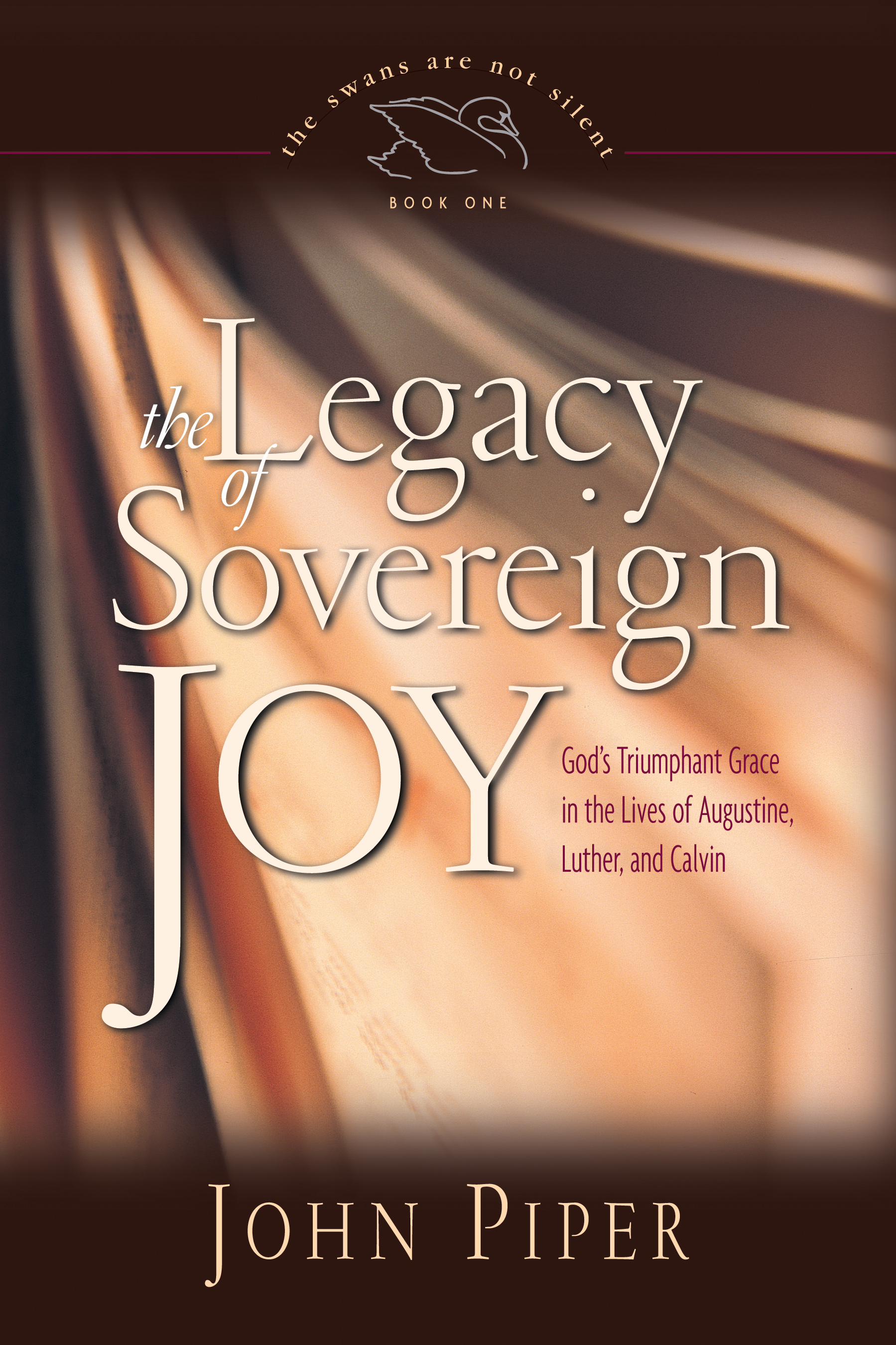
The Legacy of Sovereign Joy: God's Triumphant Grace in the Lives of Augustine, Luther, and Calvin (John Piper).  I loved this work by John Piper. Three longer essays on three important men.

Portrait of Calvin (T.H.L. Parker). This is one of the better (and brief!) biographies of John Calvin. I really appreciated Parker's attention to the main events of Calvin's life without being distracted by details.

Theology

The Institutes of the Christian Religion (John Calvin, unabridged).  Obviously, this one is the longer one. It took me a year to read it through. Very much worth my time and energy though.

The Institutes of Christian Religion (John Calvin, abridged by Lane and Osborne).  Abridged = shorter! This small version removes most of Calvin's polemical (argumentative) chapters against the Catholics and Anabaptists and focuses on the positive doctrine he preached and believed.

Monday, October 6, 2014

Redemptive History: OT Fulfillment in the NT

The Bible is literary in nature. It uses words to tell a story. One story. The story of a broken people and the redemptive unrelenting grace of their God. Some have drawn a line between the Old and New Testaments, highlighting their disjunction and distinct differences instead of their unity, maybe even accepting one and rejecting the other, functionally at least. However both testaments when struck ring like a tuning fork in harmony together. The OT leads to the conclusion of the NT and the NT is out of context where it does not stand upon the OT. They are an inseparable whole, a unified narrative, the story of redemptive history.

In the previous two chapters we attempted a summary of both the Old and New Testaments giving us a framework to understand each. In this chapter we will synthesize the story of the OT and NT into one unified narrative, highlighting in particular the various ways the OT has been fulfilled in the NT as we unpack the term “Redemptive History.”

Redemptive History

Redemptive History is a term that is used to refer to the entirety of God’s plan of redemption for His people from their sin.[1] It encompasses the history of God’s promise of an everlasting covenant with His people through His Son, Jesus Christ. Redemption history includes everything God orders by His sovereign hand before the coming of Christ in time and space and everything He orders for the salvation of His people after Christ’s coming. Redemptive history is His-story, God’s story of how He redeems His people from sin. It reads all of Scripture through the lens of what God is going to do (when reading the OT) and what God has done (when reading the NT) thereby emphasizing God’s gracious initiative for sinners by underlining every line of the story in the red merciful blood of Christ.

THE STORY OF REDEMPTIVE HISTORY

The story of redemptive history surrounds the question, “How does the Old Testament link to the New Testament?” Redemptive history seeks to synthesize the two testaments, to find the link between Malachi and Matthew, a link between the varying genres of the Bible, a link between what may seem at first differing purposes from book to book. Redemptive history seeks to bring clarity to the Scripture as a whole thereby answering these questions emphatically. And it does so by tracing the crimson thread of God’s grace through Jesus Christ in the life of the sinner. Here is a synthesis of the OT and NT highlighting the story of redemptive history.

Both testaments fundamentally address the reality of the human condition. They plainly lay out the disruption of original sin and it’s transmission to all mankind. This disruption to the intended order of creation posed an eternal dilemma: mankind’s relationship to their Creator was disordered through sin and therefore disrupted their created purpose. Instead of living in worship under the Lordship of their God, mankind has sought to worship the created rather than the Creator. This fundamental problem of sin plagues the characters in both the OT and the NT.

In the midst of this problem, both testaments witness to the need for restoration, the need for redemption in their relationship with their Creator. In the OT we see a pregnant hope of a future reconciliation between Israel and their God. In the NT we live in the realization of this hope that has been disclosed. What is this link between this hope and it’s realization? Jesus of Nazareth, the promised Messiah.

“Jesus Christ is the link between the Old Testament and the New. God’s revelation reaches its climax in the New Testament—and this climax is not a new teaching or a new law, but a person, God’s own Son.”[2]

See the OT speaks of a coming Messiah, as we have seen in the previous chapters, who will one day reconcile the disordered people of God to their proper created purpose—the worship and glorification of their Maker. Or as the word of the Lord speaks to this coming hope through the prophet Ezekiel,

“I will make a covenant of peace with them. It shall be an everlasting covenant with them…My dwelling place shall be with them, and I will be their God, and they shall be my people. The nations will know that I am the Lord who sanctifies Israel, when my sanctuary is in their midst forevermore.” (Ezekiel 37:26-28)

Upon this OT promise the NT builds. The NT recounts the life of the Messiah in the Gospels, the link between the two testaments, and the implications of the redemption He brings for God’s people. The NT lives not in anticipation of God’s grace over sin, as Ezekiel prophesied, but in the realization that God has atoned for our sin and reconciled us to Himself.

“Long ago, at many times and in many ways, God spoke to our fathers by the prophets, but in these last days he has spoken to us by his Son.” (Hebrews 1:1-2a)

“But God shows his love for us in that while we were still sinners, Christ died for us. Since, therefore, we have now been justified by his blood, much more shall we be saved by him from the wrath of God.” (Romans 5:8-9)

The OT anticipates the coming grace of God and the NT unpacks the realization of this grace. This linking relationship between the two testaments is grace. Both exist in unity to tell the same story, the story of a merciful and loving God. Both testaments are linked by this grace, the Messiah, the savior, Jesus. When read through this lens Scripture presents a unified encounter between humanity and their gracious God.

This is the story of redemptive history. It is fundamentally God’s story of how He reconciled his broken people to Himself. Redemptive history is a term that emphasizes the important of context. Therefore every text in Scripture, because of it’s overall context, is linked by Christ to the good news of the Gospel for sinners.

God Designed Redemptive History For His Glory

In light of our understanding of redemptive history, the story of the Old and New Testaments are not mere happenstance. The events recorded were not merely accidental through the exercise of human will. The narrative of both testaments were a planned reality. Redemptive history is His story, designed for His ultimate end for all of creation: His Glory. Redemptive history, the thread of redemption in Christ between the Old and New Testaments (prefigured in the OT and realized in the NT), is the fulfillment of this design.

As the Author of the story, God timed the linking event of Jesus life and death according to the purpose of that which might display His glory most. Some people may ask why Jesus came in time and space when He did, they may say “Why didn’t Jesus come in the garden after Adam and Eve sinned?” We may not be able to give a definitive answer, but we do see two dispensations of history, one in which God’s people know how desperate they are for His saving grace, and one in which they know how gracious God has been towards them in Christ.

Knowing our need is essential for giving praise. If you were sitting at home with a glass of cold water from the tap, your thirst would not be dire. But if you were in a desert far from water, you would know your need. How much more glorious would be the stranger you come across with a glass of cold water in the desert than that person in your home. The same proves true with our praise of God. Only when we know how destitute we are in our sin do we know the weight of praise God deserves from us. And so God in His sovereign will brings about the culmination of our salvation according to His sovereign timing for His glory.

“In him we have redemption through his blood…making known to us the mystery of his will, according to his purpose, which he set forth in Christ as a plan for the fullness of time, to unite all things in him, things in heaven and things on earth.” (Ephesians 1:7a, 9-10)

“But when the fullness of time had come, God sent forth his Son, born of woman, born under the law, to redeem those who were under the law, so that we might receive adoption as sons.” (Galatians 4:4-5)

Scripture is a story of a created purpose. The entire OT leads to this reality, that the people would “Know that I am Lord.”[3] Then in Christ the grounds for our boasting in God was accomplished, “The work of Christ on earth, and especially his crucifixion and resurrection, is the climax of history, it is the great turning point at which God actually accomplished the salvation toward which history had been moving throughout the OT.”[4] The end of redemptive history is God’s glory. Another way of putting it would be that God’s glory is the fulfillment of God’s redemptive plan in Jesus Christ.  How is God glorified as the OT is fulfilled in the NT?

God is Glorified Through the OT Fulfillment in the NT

The story of redemptive history highlights the awe-inspiring connection between the OT and the NT, the grace of God in Jesus Christ. At the center of both testaments is the theme of God’s promises and their fulfillment. The OT surrounds the promises of God for His people. It isn’t until the NT that the fulfillment of these promises and institutions are finally realized. As one thirsts for water and rejoices in a cold glass, so too as we look at the OT promises fulfilled in the NT we will rejoice in God’s goodness towards us and raise our praise of thanks. Let’s turn to the progression of a few of the ways God plans in the OT are fulfilled in the NT.

THE OLD AND NEW COVENANTS

A covenant is a binding promise between two individuals. God makes a covenant in the Garden of Eden to Adam and Eve, a promise based on works. Adam and Eve were promised an eternal relationship in the presence of God if they would submit to refraining from eating “of the tree of the knowledge of good and evil” (Gen. 2:17). We call this promise the “Old Covenant” or the “Covenant of Works.”

The Westminster Confession puts it this way, “In [the old covenant] life was promised to Adam and through him to his descendants, on the condition of perfect, personal obedience.”[5] However the fall of Adam and Eve by disobeying God through eating of the tree shattered the covenant of works. It did so for every person as this single act of sin spread to every descendant of mankind. No person, because of the far reaches of sin in every area of life, could now fulfill this covenant through a life of perfect obedience. It is impossible to earn our salvation by works, “so we also have believed in Christ Jesus, in order to be justified by faith in Christ and not by works of the law, because by works of the law no one will be justified” (Gal. 2:16b).

But in the midst of our rebellion, it pleased God to institute a “New Covenant,” a “Covenant of Grace.” Jeremiah records God’s promised covenant of grace:

“Behold, the days are coming, declares the Lord, when I will make a new covenant with the house of Israel and the house of Judah…I will put my law within them, and I will write it on their hearts. And I will be their God, and they shall be my people…For I will forgive their iniquity and I will remember their sin no more” (Jer. 31:31, 33b, 34b).

Now in the NT, at the Last Supper, Jesus declares that He is the fulfillment of this new covenant, “This cup is the new covenant in my blood” (1 Cor. 11:25).[6] Through Jesus’ death on the cross God promises us redemption—not through a fulfillment of legal demands and works—but instead now through faith which is itself a gift from God. The new covenant is an emphatic fulfillment that God is a God of grace to His people. In Christ the promise of relationship that God gave to Adam is fulfilled to all whom by faith rest in the promise of God. When God’s people through faith experience this grace, God becomes increasingly more glorious to them.

THE MEANS OF ATONEMENT

The entrance and subsequent universal spread of sin to all mankind is the problem that God deals with throughout all of redemptive history. Atonement is the means by which God redeems His people from sin. In the OT atonement happened primarily through the sacrificial system. Once a year on the Day of Atonement God’s people through the high priest would offer a blood sacrifice, two male goats, for the forgiveness of their sins as a whole (see Lev. 16). In the giving of the law to Moses, God provided this means of atonement that His people might know the seriousness of their sin, the seriousness bloodshed symbolized, and the graciousness of God to forgive them.

Now in the NT, the OT atonement sacrifices have been fulfilled in Jesus Christ. In the OT only the high priest could offer sacrifice on behalf of the people as their mediator. In Christ we have an eternal high priest who advocates for our redemption, “We have such a high priest, one who is seated at the right hand of the throne of the Majesty in heaven, a minister in the holy places” (Heb. 8:1).

In the OT the sacrifice was a continual sacrifice, done year in and year out. But as John Stott so clearly puts, “The Old Testament blood sacrifices were only shadows; the substance was Christ. For a substitute to be effective, it must be an appropriate equivalent.”[7] Jesus was an appropriate equivalent; He was fully human and completely righteous. Therefore God offered Himself as a sacrifice through the bloodshed of His Son on the cross once and for all, not to be repeated year by year, “He entered once for all into the holy places, not by means of the blood of goats and calves but by means of his own blood, thus securing an eternal redemption” (Hebrews 9:12).

The means of atonement has been perfected, it has been fulfilled through Jesus. We are “justified by his grace as a gift, through the redemption that is in Christ Jesus, whom God put forward as a propitiation by his blood, to be received by faith” (Rom. 3:23-24). Our redemption stands now upon a God who took Himself out of grace and mercy to the cross, to die the death we deserved, so that we might have the life with Him that we were created to share in. God is glorified by overwhelming the hearts and minds of His saints by displaying what lengths He will go through to redeem them.

THE ULTIMATE PROPHET, PRIEST, AND KING

In the OT there were three prominent leadership offices, prophet, priest, and king. The prophet’s task was to speak God’s word to His people. God did this through such prophets as Moses, Elijah, Isaiah, and Daniel. God promised that another prophet would come,

“The Lord your God will raise up for you a prophet like me from among you, from your brothers—it is to him you shall listen—just as you desired of the Lord your God…I will put my words in his mouth, and he shall speak to them all that I command him” (Deuteronomy 18:15-16a, 18).

Jesus is the promised coming prophet. Whereas all OT prophets spoke a word from God, Jesus was the Word from God, the logos, because He was God. He came as His own prophet to declare the good news of the fulfillment of God’s promise to His people. The fulfillment of redemption in Himself. Jesus did not need to say “Thus says the Lord,” instead he simply spoke with authority and every word spoken was a “Thus says the Lord.” Jesus fulfills the office of prophet and we have the privilege of His authority and declarations recorded for us in Scripture.

The OT also spoke of the office of the Priest. Priests existed to offer sacrifices to God on behalf of His people for their atonement. They mediated the relationship between the people and their God. However instead of continuing a succession of priests from the Levitical line, God brings a fulfillment to the office of priest through Jesus. As priest He is our eternal mediator, “always [living] to make intercession for [us]” (Heb. 7:25). As priest, as we have just looked at, He offers atonement for our sins, not by means of animal sacrifice, but by displaying His love and mercy towards us by offering Himself as our atoning sacrifice. The fulfillment of the priestly office in Christ is of great consolation for no sinner could mediate as Christ does.

Whereas the prophets and priests were God’s idea to instituted, the office of King in the OT was not, it was a slap in the face to God. Judges were not good enough for Israel. They wanted to be like their neighbors who had kings rule over them. But God was their king. However in God’s grand story of redemption He institutes a human kingship under His own kingly and sovereign rule. Kings Saul, David, and Solomon rule somewhere between faithfulness at times and rebellion at others. The long line of kings from onward from them is a ghastly portrayal of power and human wickedness. Kingship is abused.

But the kingdom of God is not ruled by sinful human kings. Instead Jesus comes as the Messiah, the righteous human king. “Blessed is the king who comes in the name of the Lord!” (Luke 19:38). He is “King of Kings and Lord of Lords” (Revelation 19:16). He rules God’s sovereign kingdom in righteousness. He fulfills our desire for a king, a ruler to govern us for our wellbeing and flourishing. He is the eternal king whom we are to joyfully bow our knee to every day.

Conclusion

So throughout the story of both the Old and New Testaments we see a unity, a vivid portrayal of God’s plan of redemptive history enacted through His love and care for His people. The institutions of the Old Testament give way to their fulfillment in the New through God Himself entering the story in the person of Jesus. Redemptive history is the greatest story ever told and we have the privilege of each being cast a role as it moves closer and closer to it’s ultimate fulfillment at the end of the age.

*     *     *

JT Holderman is Associate Pastor of Bellevue Evangelical Presbyterian Church in Gap, PA.


[1] For a further exposition on the subject of Redemptive History, see Geerhardus Vos, Biblical Theology: Old and New Testaments (Carlisle, PA: Banner of Truth Trust, 2012); Jonathan Edwards, A History of the Work of Redemption contained in The Works of Jonathan Edwards, vol. 1 (Carlisle, PA: Banner of Truth Trust, 2009), pp. 532-619.
[2] Sidney Greidanus, Preaching Christ From the Old Testament (Grand Rapids: Eerdmans, 1999), p. 49.
[3] Scripture speaks in many places of God ordering all of history so that the nations will know that He is the Lord: cf. Exodus 6:7, 7:5; Isaiah 49:26, 60:16; Ezekiel 5:13, 20:42; Joel 2:27, 3:17.
[4] The ESV Study Bible (Wheaton: Crossway, 2011), 23.
[5] The Westminster Confession of Faith, 7.2.
[6] However the Covenant of Grace is prefigured in the OT: It begins with Adam and Eve. God had every right to simply wipe them out for their sin, but instead he extends grace based on nothing they have done to deserve it. God also extends a covenant of grace to Abraham in Genesis 15 and 17 in which God promised him progeny and the promised land apart from any works. The covenant of grace abounds in many other places in the OT.
[7] John Stott, The Cross of Christ, p. 138.

Friday, October 3, 2014

Should Abortion Providers Have Surgical-Quality Medical Standards?

I try really hard to understand where abortion advocates come from.

I honestly do attempt to understand their reasoning to discern why they are so passionate about their conviction that women - all women in fact - should have immediate, free, unimpeded access to abortion services. Preferably paid for by you and I, the taxpayers.

But I just get so confused by their logic.

We are told, routinely and regularly by abortion-on-demand advocates that "If we outlaw abortion, women will be forced to resort to back-alley butchery." That the clothes hanger will be the surgical implement of choice of pregnant teens, unwed mothers, and minority groups. They would have us believe that women will bring themselves greater harm than if abortion-on-demand was simply provided and payed for by John Q. Public. Heard that argument before? Me too.

But follow the logic of their argument now:

The State of Texas has recently won an appeals court ruling that legally requires the enforcement of higher standards for abortion facilities. This means that the facilities in which abortions are performed must be clean, sterile, and meeting state of Texas standards of excellence. In fact, the requirements and standards are so tough that they must meet hospitals' surgical level quality controls.

The pro-abortion camp should jump for joy right? They've been arguing for safe abortions all along haven't they? Aren't they all about "women's health"? Who would want dirty, sub-quality back-alley operations?

Apparently, the pro-choice camp does, that's who.

You see, this new ruling that requires abortion providers to meet surgical standards of quality control will essentially enforce the shut down of most of Texas' abortion operations, almost 40 clinics. Only seven (just seven!) meet the standards of a decent local hospital. As far as this writer is concerned, good bye and good riddance to those disgusting clinics.

Think about it: Haven't the abortion-on-demand folks been telling us that an abortion is a mere medical procedure? Just a surgery? Something akin to the removal of an appendix? Haven't they been telling us that abortion doesn't stop a beating heart but is just "the removal of a lump of tissue?" If an abortion is just a personal elective surgery (as they would have us believe) it should meet the standards of ALL other surgeries. "Women's health" would seem to require that. Right?

But no.

The abortion advocates tell us this law is unfair. A travesty. "A state of emergency," as described by one abortion  advocate. Now these folks want us to believe that women deserve their abortions and they should have the right to get them in disgusting, dirty, unsanitary facilities like the one that Dr. Kermit Gosnell ran.

So who is really pro-women here?

-Matthew Everhard is the Senior Pastor of Faith Evangelical Presbyterian Church in Brooksville, Florida. 

Tuesday, September 30, 2014

The New Testament: A Ten Minute Overview

The New Testament is the consummation of the Old Testament. It is a continuation of God’s grand story of redemption for His people. The story of the OT moves from Creation to Fall to Promise and ends with the promise unfulfilled.  At the end of the Old Testament we are left waiting on the fulfillment of God’s promise to redeem His people from their sin.

It is here that we encounter the story of God’s plan to enter bodily into the story through His Son Jesus, the Messiah, and through His life, death, and resurrection redeems His people. In the New Testament we see the staggering claim God’s people are not only the people of Israel, but includes every other race as well, the Gentiles.[1] This is good news for all sinners, both Jew and Gentile alike.

While the OT can be classified in large part as historical narrative, the NT narrative is complex. The following framework is a helpful map to understanding the progression of the NT as a literary whole.

The movement of the NT surrounds God redeeming His people from sin through the Messiah. It is the story of a covenant, a promise from God to His people that is fulfilled in Jesus Christ. Therefore we can divide the NT into three narrative portions: 1) Messianic Fulfillment primarily in the Gospel accounts of Jesus’ life, ministry, and redeeming death, 2) Messianic News recorded for us in the creation of the early church in Acts, and 3) Messianic Implications for mankind in the epistles. If we view the NT through this lens we can easily see the storyline of the text surrounding the Messiah, moving from the fulfillment of God’s promise, to the sharing of this good news, to the radial implications the Messiah brings to all human life.

What Composes the New Testament?

The New Testament was written between AD 40-96, the earliest being the Epistle of James attributed between AD 40-45[2] and the latest being John’s Revelation attributed between AD 95-96.[3] It includes 27 books covering two different genres:

History: Matthew, Mark, Luke, John, Acts.

Letters: Romans, 1-2 Corinthians, Galatians, Ephesians, Philippians, Colossians, 1-2 Thessalonians, 1-2 Timothy, Titus, Philemon, Hebrews, James, 1-2 Peter, 1-3 John, Jude, Revelation.[4]

The New Testament was written primarily in common Greek (Koine Greek), widely understood in Palestine at the time. A few portions were also written in Aramaic.[5]

The New Testament is of infinite value to the reader. Why? Because of the life-altering message of good news it shares for both Jews and Gentiles. It holds staggering implications for every area of life including most importantly our eternal purpose, either glorifying God in heaven or glorifying self in Hell. Let’s look now at the conclusion of the OT, the staggering story of grace in the NT.

1) The Messianic Fulfillment

The New Testament is a continuation of the Old, an awesome conclusion to the cliffhanger that separates the Old and New Testaments, God’s promise of salvation. The NT fulfills the glaring problem of sin and our separation from God by revealing to us the completion of His covenant with David:

“Moreover, the Lord declares to you that the Lord will make you a house…I will raise up your offspring after you…I will establish the throne of his kingdom forever. I will be to him a father and he shall be to me a son” (2 Samuel 7:11-14).

But the promise throughout the OT of a Savior for God’s people is not simply this promise to David. The promise of a Messiah is fills God’s revelation in the OT:

“Surely he has borne our griefs and carried our sorrows; yet we esteemed him stricken, smitten by God, and afflicted. But he was wounded for our transgressions; he was crushed for our iniquities; upon him was the chastisement that brought us peace, and with his stripes we are healed. All we like sheep have gone astray; we have turned—every one—to his own way; and the Lord has laid on him the iniquity of us all.” (Isaiah 53:4-6) 

“Rejoice greatly, O daughter of Zion! Shout aloud, O daughter of Jerusalem! Behold, your king is coming to you; righteous and having salvation is he, humble and mounted on a donkey, on a colt, the foal of a donkey.” (Zechariah 9:9)

“For to us a child is born, to us a son is given; and the government shall be upon his shoulder, and his name shall be called Wonderful Counselor, Mighty God, Everlasting Father, Prince of Peace. Of the increase of his government and of peace there will be no end, and on the throne of David and over his kingdom, to establish it and to uphold it with justice and with righteousness from this time forth and forevermore.” (Isaiah 9:6-7)[6]

The OT paints a robust picture of the salvation of God’s people through a Messiah. As the completion of this promise, the Gospel accounts of Jesus’ life emphatically paints the picture that Jesus is the Christ—the Messiah—the “Son of David.” Through His life and death Jesus is the fulfillment of God’s promise to David of an eternal King who redeems His people.

“He will be great and will be called the Son of the Most High. And the Lord God will give to him the throne of his father David, and he will reign over the house of Jacob forever, and of his kingdom there will be no end.” (Luke 1:32-33)[7]

“Blessed be the Lord God of Israel, for he has visited and redeemed his people and has raised up a horn of salvation for us in the house of his servant David, as he spoke by the mouth of his holy prophets from of old…to show the mercy promised to our fathers and to remember his holy covenant.” (Luke 1:68-70, 72)

How did the Gospels record this Messianic fulfillment for us? Let’s look at the biographical sketch that the Gospels give us of Jesus as the Messiah fulfilled.

The Life of Jesus in the Gospels

The story of Jesus of Nazareth begins prior to His birth, which most likely would have been between December of 5 BC and January of 4 BC. [8] Before His birth, an angel of the Lord brings good news to Mary that she will give birth to the eternal King, Son of David, Son of God, (Luke 1:32-33). This is the first emphasis of Jesus as the Messiah in Luke. In the City of David, Bethlehem, Mary gives birth to Jesus (Luke 2:1-7) and He grows up nearby in Nazareth.

The earliest account of his life occurs as a boy teaching in the Temple in Jerusalem where His wisdom was already on display to the people (Luke 2:49).

Jesus’ public ministry then began with his baptism. Jesus had now left his work as a carpenter to devote himself to the public ministry of good news for all the people. After His baptism, the declaration of His public ministry, Jesus entered the wilderness to be tempted by Satan. No temptation swayed Him. He did not sin. Nothing would hinder Jesus from His mission to “seek and to save the lost” by living a perfectly righteous life to be substituted one day for the sin of others, thus fulfilling His purpose as the Messiah.

Jesus spent three years ministering all over Israel, Judea, Galilee, Samaria. He raised up twelve disciples whom He called to the task of being His witnesses to the ends of the earth. He performed miracles, He healed the sick, He spent early mornings in prayer, He preached repentance and grace, He glorified His father, He was tempted in every way we are but never sinned, He spoke with authority, He was the Son of David, the Son of God.

Jesus’ life and ministry all moved to one place, the Roman torture device: the cross. His mission was not simply to teach and live a righteous life; it was intended all along to take Him to His death so that by His death many who by their sins have been condemned to death might have life. Without the cross there is no salvation. Without the cross Jesus is not the Messiah, the savior of God’s people, “For it was by his death, and not by his resurrection, that our sins were dealt with.”[9]  Therefore, “According to the generally accepted chronology, Jesus died late Friday afternoon, April 7, A.D. 30.[10] Three days later, on a Sunday morning (why Christians now worship on Sunday rather than the Jewish Sabbath of Saturday), the tomb was empty. Jesus rose from the dead and appeared to hundreds in His risen bodily form. Forty days after Jesus’ resurrection, he ascended into heaven leaving behind disciples and witnesses to carry on the ministry of the Gospel, the declaration of the good news of Jesus as the Messiah, Jesus the Christ.

Each of the Gospels vary in their written style and audience. Matthew, Mark, and Luke comprise the Synoptic Gospels, Matthew and Luke believed to have been written with some uniform knowledge of Mark. Scholars attribute their uniformity in events to this possible theory. Matthew was a Jewish tax collector who wrote the account of the Messiah for a Jewish audience. Mark was a Jew whose primary audience was Gentiles. Luke was a doctor whose primary audience was Gentiles as well. Roughly 90% of John’s material is unique to John. He wrote primarily to Gentiles to show that Jesus was God, a call for them to have faith in Him for their salvation.

2) The Messianic News

The Gospels recorded the events of the Messiah’s life, death, and resurrection, thereby emphatically claiming Jesus to be the messianic fulfillment as the Son of God. Luke, the author of the Gospel in his name, also wrote another work detailing the spread of the news of Jesus as the Messiah in the early church: the Acts of the Apostles. In the Gospels Jesus’ fulfillment is dropped like a rock into a still lake, it records the splash. In Acts we see the ripple effect of that splash recorded for us in vivid detail. Where Jesus is witnessed in the Gospels, it is here in Acts that the news spreads and the church comes into being.

In Acts the good news spreads, over the 30 years following Jesus’ ascension, with such power that it brings salvation to many, creating churches all over the Mediterranean, from Jerusalem to Rome. In the opening chapter Jesus ascends into heaven where He now intercedes for us at the Father’s right hand (Acts 1:6-11). Quickly after this the promised Helper, the Holy Spirit is given at Pentecost.

Acts can be divided from the lens of a flyover generally between the witness of two apostles, Peter and Paul. Peter acts as a witness to the Jewish people, preaching at Pentecost, in the Temple square, before the Jewish council, and in many other locations. His emphasis is on Jesus as the good news of Messianic fulfillment for the Jews, claiming exclusive salvation through Jesus: “And there is salvation in no one else, for there is no other name under heaven given among men by which we must be saved” (Acts 4:12).

It is here in the beginning of Acts that we also witness the first martyr for the Gospel. Stephen was arrested for performing great signs and wonders in the name of Christ by some who “could not withstand the wisdom and the Spirit with which he was speaking” (Acts 6:10). He was brought before the Sanhedrin where he preached the fulfillment of the promised Messiah in Jesus had come. They were enraged, cast him out of the city, and stoned him in the midst of a man named Saul.

This man Saul was a devout Jew with a hunger for persecuting Christians. He ravaged “the church…entering house after house, he dragged off men and women and committed them to prison” (Acts 8:3). Yet in this vilest of opposition to Christ, God made the greatest evangelist. Jesus met him on the Damascus road and blinded him, telling him to travel to Ananias who would lay hands on him enabling him to see again. Ananias questions the evil Saul has done and the Lord reveals Saul is to “carry [His] name before the Gentiles” (Acts 9:15a). Saul regains his sight, by faith changes his name to Paul, and is catapulted by the will of God to share the Messianic news to the Gentiles, where Peter was sent to the Jews.

Paul travels with Barnabas on his first missionary journey to share this news to the Gentiles. The first journey takes them through the island of Cyprus, to Perga, and Galatia. Paul returns then to Jerusalem over an issue that had arisen, the question of the Gentiles obedience to the Law. Some had said that you must be circumcised to be saved (Acts 15:1). Paul took the matter to the Jerusalem council. Here James, the brother of Jesus, proposes a solution. Circumcision is not required for salvation (Acts 15:19). The council encourages Paul in his mission to the Gentiles.

Paul then travels with Timothy on his second missionary journey to share the Messianic news. Paul travels again through Galatia starting again in Antioch. He makes his way through Asia, to Philippi, Thessalonica, Athens, Corinth and back to Jerusalem by way of Ephesus. The church is being born in the midst of these travels as the good news of Jesus is irresistible to those who are given the gift of faith.

Paul’s third missionary journey takes place in nearly the same places as his second, revisiting Ephesus, Philippi, Thessalonica, and Corinth. However upon returning to Jerusalem he is arrested for preaching and having brought Gentiles into the temple. In his arrest he appeals to Caesar, as a Roman citizen had the right to do, and journeys to Rome, by way of a shipwreck on Malta. There he lived for two years (Acts 28:30) preaching the good news of Jesus as savior, Jesus as Messiah. We do not have record of the remaining years of Paul’s life.

The news of Jesus spread through the apostles, through those who were direct witnesses to the good news of Christ. They took the news to places that the Lord by His Spirit opened up to them. The birth of the church happened through traveling evangelists, heralding and proclaiming the good news of salvation by grace alone through faith alone in Jesus Christ.

3) The Messianic Implications

While the Gospels reveal Jesus as the Christ, and Acts reveals the spread of the good news and subsequent birth of the church, the letters in the NT are written to churches and individuals regarding the implications of Jesus as the Christ for their lives.

Paul wrote most of the volume of the NT. Romans is his first letter we encounter in the NT. It is the King of the Epistles. If the Gospels are an account of Jesus as the Messiah, then Romans is an account of human history, Jew and Gentile, and the theological implications that Jesus brings for the Christians in Rome. Salvation in Christ is both for Jews and Gentiles. It is the most concise letter summarizing the theology of the Gospel that the church possesses.

Paul wrote to the church at Corinth that he spent time with on his second and third missionary journeys. In his first letter Paul addresses the need for unity in the church for the purpose of advancing the good news of the Gospel. In his second letter he defends his apostolic authority and mission to the Gentiles highlighting the witness of his suffering for the Gospel.

Paul then wrote to a few other individual churches that he came into contact with on his missionary journeys. He wrote to the Galatians exhorting them that circumcision, i.e. fulfilling the law, was not required for salvation. To the Ephesians he wrote to encourage them that salvation is by faith alone because Christ has conquered sin. To the Philippians Paul wrote to commend them for their faithfulness and encourage them in the midst of their suffering. To the Colossians he wrote warning them against false doctrine and stressed the absolute supremacy of Christ. To the Thessalonians Paul wrote two letters, the first encouraging them that those who have already died will be raised at the second coming and the second letter correcting a false teaching that the second coming of Christ had already taken place.

Paul also wrote four letters to individuals, Timothy, Titus, and Philemon. In Paul’s first letter to Timothy he writes indicting false teachers and encouraging Timothy to confront them, that the true Gospel will always lead to godly living. In the second letter to Timothy, Paul encourages him to remain loyal to Christ and the message of the Gospel. To Titus he sends instructions for how to order the churches of Crete. To Philemon he wrote securing forgiveness for a slave named Onesimus, thereby exhibiting how the Gospel transforms lives and relationships.

Hebrews, whose author is widely disputed, is a word of exhortation sent to encourage the faithful perseverance of persecuted Christians. The author emphasizes that Christ is infinitely greater than any angel, priest, or old covenant institution.

James writes a letter to the Jewish Christians, who are dispersed far from Jerusalem, to primarily encourage them to live their lives as a witness to the good news of the Gospel. They are to be doers and not just hearers; they are to live out their faith as witnesses to the implications the Messiah brings.

Peter writes two letters. In his first he writes to Christians who are suffering, instructing them to respond to their persecutors by suffering as Jesus did. In his second letter he urges growth and perseverance in light of false teachers who deny the second coming of Christ and instead use it as a license to act immorally.

John writes three short letters. In his first letter John calls believers back to three basics, 1) true doctrine, 2) obedient living, and 3) fervent devotion to Christ. In his second letter John writes to encourage his readers to love each other and to beware false teachers who deny the incarnation of Christ, that He wasn’t really human. In his third letter John writes to Gaius commending the hospitality of Demetrius.

Jude, one of the brothers of James and Jesus, writes to a congregation of Jewish Christians exhorting them to look out for false teachers who have slipped in and used grace as a license to sin.

Finally, John concludes the NT with his apocalyptic letter, Revelation. He writes to persecuted Christians encouraging them that God indeed is in control. He wins the cosmic story through His Son, the Christ. Revelation is an apocalyptic prophecy revealing the unseen spiritual war and cosmic conflict dealing with the salvation for God’s people from their sin and His wrath. Ultimately Revelation acts a shot in the arm to fortify the church to endure suffering and stay pure.

Conclusion

The NT is the consummation of the OT. In it we see the fulfillment of God’s promise of salvation. In the Gospels the Messianic promise is fulfilled. In Acts the Messianic good news spreads from Jerusalem to Rome creating the church. And in the Epistles, we see the implications of Jesus as savior. With the conclusion of the NT we have the conclusion of God’s revelation in Scripture for our flourishing and His glory. It is a testament to the grace and love of our God in spite of all the rebellion we can muster against Him.


[1] Israel can clearly be classified as God’s people in the OT. However books like Jonah reveal that God’s grace is also meant for other Gentile nations like the Ninevites. Jonah is a precursor to the inclusion of Gentiles as God’s people in the NT.
[2] Douglas Moo, The Letter of James (Grand Rapids: Eerdmans, 2000), 25-26.
[3] Alan Johnson, The Expositors Bible Commentary (Grand Rapids: Zondervan), 581-582.
[4] Revelation is sometimes classified in it’s own genre as “Apocalypse,” but begins as a letter to seven churches so many have also included it in the category of Epistle.
[5] Aramaic was a Semitic language, similar to that of Hebrew. The Assyrians made Aramaic a common language during the Jewish exile in the sixth century BC. For many of the Jews in Palestine, this was the prominent language.
[6] See also Jeremiah 23:5-6
[7] See also Mark 10:47-48 and Matthew 3:17
[8] Bruce M. Metzger, The New Testament: Its Background, Growth, and Content (Nashville: Abingdon Press, 2003), 124. Most scholars attribute this dating for the birth of Jesus, though there are many differing views as well.
[9] John Stott, The Cross of Christ (Downers Grove: InterVarsity Press, 2006), 233.
[10] Bruce M. Metzger, The New Testament, 149. Though many argue as well for His death to have occurred in AD 33.