
Showing posts with label ecclesiology. Show all posts

Thursday, September 11, 2014

Stay at Home Christians: Leaders of the World's Smallest Cults?

For a while, I have been pondering the phenomenon of Stay-at-Home Christians. Before I propose something rather controversial, let me define the group that I am talking about.

They are not shut-ins with protracted health problems. They have every means necessary to attend a Bible-believing church, but simply choose not to. They are not unreached. I am not writing about those who live in places with few or no open expressions of Christian faith like North Korea or Iraq. I'm not talking about those who are imprisoned for their faith. Dietrich Bonhoeffer is off the hook in this article. I should also clarify that I am not talking about the paradigm of local churches meeting in homes. This article is about ecclesiology (our view of the nature of the church) not architecture (what type of buildings Christians should meet in).

I'm talking about that ever-growing demographic of people who have every opportunity to attend a local assembly of confessing Christians, but simply choose not to. They got bored and left. They got offended and never came back. Someone sat in their pew and they got ticked. They lost a close vote at the board meeting and split, never to darken the doors again. The pastor said the wrong thing on the same day the band played the wrong song. Whatever.

If you ask them, they will say devoutly, "I worship at home. I have a personal relationship with Jesus Christ. I read my Bible. But I don't need the church." 

Sometimes you will recognize a S.A.H.C. by their particular vocabulary. Church for many is merely "organized religion." And they want no more of it. (I am always tempted to ask in a snarky tone whether they would prefer the opposite, "disorganized irreligion," but I usually don't go there).

But to pose the question more directly: are these professing Christian believers actually closer in practice to cults than orthodox Christianity? 

One of the definitive works on cults, is Walter Martin's The Kingdom of the Cults. To my knowledge, he does not mention this classification of people. So they're orthodox, right? Not so fast.

To answer my own question more precisely, we will have to look at the typical markers of a cult and see whether or not Stay-at-Home Christians would qualify. Let's consider several.

A) Authoritarian and Unchallengeable Leadership. For instance, in the Jehovah's Witnesses cult, the headquarters of the Watchtower Bible and Tract Society is unchallengable. No mere member has the right to question their teaching. Or correct their interpretation. The same with the Branch Davidians. All directives go downward, from the top.

Although Stay-at-Home Christians do not have any formal leadership structure at all, with each man functioning as his own senior pastor and guru, that's exactly the problem. It is worrisome to me when one's own opinion is regarded as the highest and best. Who else would he listen to? What other voice can he heed? He has no one to whom he submits, excepting his own conscience. He carries out his religious practices at his own dictate. In a sense, he acts as his own personal pope and bishop. RATING: SEMI-CULTIC.

B) Lack of Accountability. In most cults, there is no process by which a "person in the pews" can call a leader into account. There are no presbyteries for accountability. There are no General Assemblies, or Regional Conferences to whom one may appeal for help or to reign in an unrepentant leader. In the case of moral failure, (sexual, financial or otherwise) no one can call the leadership into account. No one can hold their feet to the fire. For this reason, cult leaders often are able to get away with much sinful license that orthodox church leadership cannot. In fact for the cult, accountability is a bad idea. Accountability would only get in the way of a leader's pursuit of his own passions and power. He doesn't want any speed bumps.

So too, I think, with the S.A.H.C.  If a man or woman falls into sin - for instance marital infidelity - there is no "church disciplinary" process that automatically kicks into affect. As a Presbyterian minister myself, if I committed adultery, I would have to face a Presbytery commission to reprimand me. But who is in a position to reprimand the S.A.H.C.? Sure, a person could check themselves into rehab or turn oneself into the police in extreme cases. But would he have to? Of course not. There are no council of elders, or deacon board, or ranking bishop to call one to accountability. There is no congregation to vote out the leader because he is both the congregation and the leader. RATING: CULTIC.

C. Unorthodox Theology. Cults are known for their unorthodox theology that veers far from the historic Christian faith. Cults do not profess such historic documents as the Apostles Creed or Nicene Creed or the Chalcedonian Definition. Neither do they profess the confessions of Reformation-era Christianity such as the Westminster or the Heidelberg. Their views of Jesus (Christology) are all over the map. Doctrines such as the Trinity and the eternality of Hell are usually the first to go. After that is the infallibility of Scripture. While some go far afield in sexual ethics, (the Mormons and polygamy for instance), others still attempt to live holy, if legalistic lives.

As for Stay-at-Home Christians, their theology and doctrinal convictions are impossible to categorize since the wide scope of their beliefs are unique to each individual person. Each man defines truth for himself. One man may believe this, another that. In fairness, a Stay-at-Home Christian may know his Bible better than most. But maybe not. Who knows? There is no one there to correct him. No one there to teach him or steer him away from error. One S.A.H.C may quite like the Westminster Catechisms, while another cannot even define "justification." Another likes Oprah's views. Still another the preaching of Joel Osteen. Their theology is simply too messy to attempt to analyze. The point is, there is no way to tell. RATING: QUESTIONABLE.

D. Ecclesiology and Sacramentology. Cults often have very unique definitions of the church itself and the sacraments (or ordinances) of the Lord's Supper and Baptism. Many simply will not practice them at all and create their own pseudo-sacraments. These expressions of corporate faith are as variant as they are numerous.

As for S.A.H.C.'s their expressions of the church cannot possibly be orthodox, in my view. The very word "church" in the NT Scriptures (Greek: ekklesia) is plural and means "called out ones." A lone individual can be a member of a church, but not the church. One can be a member of the body (to use Paul's analogy in Romans 12 and 1 Corinthians 12), but he cannot be the whole body.

Since it is impossible to baptize oneself or serve oneself the Lord's Supper (all of Paul's dictates to the Corinthians about the Lord's Supper presuppose a corporate gathering of believers) we have to assume that both the ecclesiology and understanding of the Biblical ordinances of the S.A.H.C. movement is deeply flawed. RATING: CULTIC.

E. Other Beliefs and Practices. On the other hand, there are probably dozens of practices of S.A.H.C.'s that do not evidence cult-like behaviors at all. I don't sense a strong desire on the part of this movement to manipulate or control people, for instance. Neither do I detect a strong evangelistic outreach or campaign to win people to their views, as is often evidenced in many cults. I don't see much financial motivation to work Ponzi Schemes over on people, and undo their adherents financially as many cults have been wont to do. The only possible financial motivation I can detect in this movement is probably a reticence to tithe of their income to any local church. RATING: NON-CULTIC.

Conclusion

In conclusion, then, while probably not cults by any traditional definition, we do find some disturbing patterns among Christians who profess Jesus Christ as Savior, but who eschew the Church that He bought with His own blood (Acts 20:28). Many of the foundational beliefs and patterns appear cultist in some respects, and many others are borderline, albeit without any motivations or aspirations towards gaining power among a great many followers.

I believe we should show great concern and love for those who reject the corporate expression of the Body of Christ (Romans 12:3-8; 1 Corinthians 12:12-14). I think their position is precipitous in many ways without necessarily being outright heretical.

In some cases, we ought to regard S.A.H.C.'s as sincere believers who have back-slidden considerably, and are in great need of the love and care of a local church. In other cases we ought to treat them as those who have yet to be converted (1 John 2:19). Certainly great grace should be shown on our part, and no little charity as well.

Matthew Everhard is the Senior Pastor of Faith Evangelical Presbyterian Church in Brooksville, Florida. 


Friday, May 16, 2014

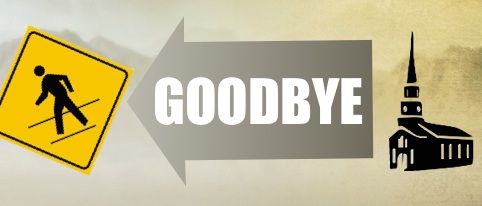
How to Leave Your Home Church (Without Losing Your Soul or Denying the Faith)


"They went out from us, but they were not of us; for if they had been of us, they would have continued with us. But they went out, that it might become plain that they all are not of us."
 (1 John 2:19). 


Alright. I admit that the title I gave this post is a bit provocative.

"Losing your soul?" Isn't that a bit much?

Yes. It certainly sounds serious, doesn't it? But so does the quotation from the Apostle John above. After all, the teaching of the Apostle is that leaving the visible Body of Christ can often reveal those who have made false professions of faith. Try as I might, I can't soften up the Apostolic teaching. So I won't.

Clearly leaving the Body of Christ--as it is expressed in the local church--is a very serious matter indeed.

And no, I don't believe that we can lose our salvation. But many make false professions to be sure (Matthew 7:21-22).

Is Leaving Right? 

There may be some times when leaving your home church is absolutely the right thing to do. When a local church or denomination has committed apostasy to the extent that the Gospel is utterly compromised, and the visible institution no longer exhibits the Reformation's three "marks" of a true church (the preaching of the Word, the right administration of the sacraments, and the exercise of godly discipline) it may very well be time to go.

Sometimes it may be necessary to leave one's home church due to major theological differences that cannot be reconciled easily (Calvinism vs. Arminianism; cessationism vs. Pentecostalism etc.).

Of course, some people change jobs or relocate from time to time. That's not in question here.

But before you bolt and head down the street to the next church (or even quit going to church altogether!) ask yourself some serious questions:

1. Am I just being petty? Am I leaving because of preferences or because of foundational issues? Is mere worship style a factor? Am I going somewhere else because of something as superficial as song choices? Is it because I don't like the pastor's clothes? Or his wife? Or the color of the pews? If so, repentance is probably the better course.

2. Am I leaving behind damaged relationships that need to be reconciled? Fleeing one's home church is a dangerous thing. One such danger is that I may be leaving because I am avoiding the hard work of reconciling relationships.

Sure, its easier to say "Goodbye!" than "I'm sorry!" or even "I forgive you!" Does anyone read Matthew 18:15-20 and think it sounds easy to carry out? Living in light of Jesus' teaching in Scripture is always hard. That's why He called it "carrying your cross" and following Him (Matthew 16:24). And yet His way is always right.

Before you leave, take the time to restore as many broken personal relationships as possible. Go back one more time and try to repair what has been broken. If you cannot, at least you will have the personal peace of knowing that you tried. In our congregation, we ask new members to sign a form that says that they have tried to do their best to restore broken relationships before joining our church. I wish others would do the same.

Let me be clear: If you are running away from the difficult work of reconciliation, you are running away from your own sanctification.

3. Did I even let my (former) leadership know of my decision? It used to be that the common courtesy was to send a transfer letter of membership to one's former congregation letting them know that one had moved or changed direction. But today, I can't even tell you when the last time is that I have received such a letter.

I suppose it is because we have a totally corrupt view of local church membership. The idea of the "covenant community" seems to have been obliterated. Most just bolt without even saying farewell. In my own experience, a few have used their departure as an opportunity to "stick it to the man."

But let me ask you, when is the last time you've seen the old I'll-show-them-how-much-they-miss-me trick bear any Gospel fruit?

4. Am I a religious consumer? Many people leave churches without so much as a wave or salute because they do not believe in church membership at all (see above). For these folks, the church is nothing more than an ecclesiastical Wal-Mart; a retail supply chain from which to consume religious goods and services. I'll take some of this praise music here; some of that youth group there. I'll listen to this preacher's podcast here, and keep my membership on the rolls there. All of this reflects a sub-Christian understanding of the role of the local church.

5. What am I leaving to? If you are leaving your church to join another congregation, alright then. At least it is better to be in a different local church than no church at all. But have you read it's doctrinal statement? Do you know where it aligns on matters of first importance (Biblical authority, the Trinity, the atonement)? How about secondary issues (marriage, charismatic gifts, women in ministry, baptism)? Have you thought through this at all, or are you just leaving because the grass looks greener on the other side of the fence?

6. Am I even a Christian at all?  If you are in the habit of changing churches regularly, or have given up on the Biblical idea of the local church altogether--over which Jesus Christ is Lord and Head--it may be time to seriously reflect on whether you are a Christian at all.

As scary as it sounds, 1 John 2:19 may be referring to you.

-Matthew Everhard is the Senior Pastor of Faith Evangelical Presbyterian Church in Brooksville, Florida. 

Friday, March 21, 2014

On Reading 'Church Growth' Books

For my doctoral studies, one of our required courses is entitled Church Growth. Exciting right?

Like the rest of our core classes, we must read two thousand pages of literature before entering the classroom later this summer. After buying a dozen or so of these "church growth" books (at least they were cheap; there are so many of them!), I gulped reluctantly and bit in. 

I must confess that this is some of the most arduous reading I have ever done, not because it is too hard conceptually (the writing is actually quite fluffy and banal), but because of the severe beating my pride has taken. Where are the Puritans when I need them?

If most of these modern, cutting-edge experts are correct, I am doing practically everything wrong. In fact, I am hardly a "pastor" at all, by today's modern standards. Today's church leaders must be visionaries!

If my church is to grow--so say the gurus--I must do all of the following well:
  1. Enact a God-inspired "vision" for our church (read: be able to see the future and make it come to pass by an act of sheer willpower).
  2. Exude a dynamic, relevant presence in the pulpit that simultaneously inspires, convicts, inspires, leads, inspires, motivates, inspires, and rebukes--all winsomely!
  3. Launch self-replicating core groups led by omni-competent laypersons which will galvanize entire neighborhoods and suburbs with contagious Christianity. 
  4. Transform the old, "institutional" congregation by instead inspiring a "Jesus movement" that defies all the normal laws of ecclesiastical physics (like budgets and parking). 
All of this is possible, the authors assure me, because they have done it themselves. Flip the book to the inside of the dust jacket, and their credentials remind me of what I have been fearing all along: I must be a complete slacker. 

You haven't started a movement yet? Are you even TRYING?

One bio boasts that this mega-pastor's mega-church's mega-ministry has already planted 100 other churches! In chapter five, he tells readers that his goal is to plant 1,000 churches in one year, maybe even 10,000! (No, I'm not kidding).

If he is to be believed, my home church's single, solitary church plant looks pretty pathetic by comparison.

At this point, someone will accuse me of being anti-evangelistic. I assure you that I am not. If there is something that my church can do to grow faster, reach more people, or win our neighborhood with the Gospel in a more biblical way, I am all ears. I do want to learn from these experts, even if that learning forces me to see my own weaknesses (which are many) or my church's own weaknesses (to which I am often blind).

But must every pastor be a "visionary"? Must every local church transform itself into a "movement"? Is that even possible? Where does the sovereignty of God fit in?

At some point, I must be content with what God has given me: real responsibility for a real family of about 400 souls in small-town Brooksville, Florida (population: 7,719). Even if every person in my entire city attended my church--which I doubt would even be healthy--I still wouldn't have a "movement" the size of most of the authors I am reading.

But is there really anything wrong with that? I don't think so.

Perhaps there is some "church growth" that cannot be measured with metrics. Perhaps some progress in the Kingdom is invisible to human eyes. Perhaps some of the most visionary leaders are those who don't write guru-books. They just preach the Bible week after week. Show up at hospitals. Baptize babies. Perform funerals. Love people. Treat their wife and children with compassion.

Maybe faithfulness is really greater than "success" after all. I hope so.

Because if success and faithfulness are the same thing, I'm not sure it's possible for me to be either.


--Matthew Everhard is the Senior Pastor of Faith Evangelical Presbyterian Church in Brooksville, Florida. He is the author of Hold Fast the Faith: A Devotional Commentary on the Westminster Confession of Faith.

Tuesday, July 10, 2012

In Defense of Connectional Polity


By Matthew Everhard

With the close of another large General Assembly this week, the world of Presbyterianism begins to wind down what has been a very active summer of business meetings. Many of these meetings have been heated. Some have even been vitriolic. Each has spawned thousands of blog articles and Twitter posts. 

The gavels have been busy. The podiums, once polished, have since been worn dull. The overtures—both ascending and descending—have been, well, ascending and descending for most of June and July.  Most of the microphones have now been unplugged. 

Let’s look at what has been accomplished…

One assembly (PCA) dissected the theological ramifications of intinction, taking communion by dipping the bread in the cup rather than receiving the elements in two sacramental acts. Another (ARP) spent their energy debating their relationship to an academic institution’s governing board. A third (EPC) made a political statement on a few clauses in the “Obamacare” act. A fourth (PCUSA) voted on whether to invest or divest in corporations doing business in Israel. 

A brief survey of some of these more “interesting” matters debated may cause the uninitiated to ask: What is the point in all this? Indeed. What is the point? 

I freely admit that my role as a Teaching Elder in the EPC comes with far more desirable responsibilities than reviewing sub-committee minutes. I would rather preach or baptize a baby any day. For that matter, I’d even prefer a church disciplinary hearing! 

Nevertheless, I’d like to state a few reasons that all of these organizational structures are still part of the work of the Kingdom of God. 

First, the Body of Christ by definition is an organic living connection of various parts, all in submission together to our Head, Jesus Christ. Paul makes this argument in 1 Corinthian 12. Of course, one of the best ways that we show our unity in Christ is by actually meeting together to worship. At each assembly, worship is an integral part. All the assemblies that I know of received communion as a major focus of the event. The worship and sacraments tend not to get much press, but are central to our summer meetings.
Second, meeting together as believers on a regional (presbytery) national (assembly) or even global scale is a biblical act. Acts 15 is the account of the Jerusalem council where one of the most pressing theological questions of the day was settled, that of the inclusion of the gentiles. This meeting took place by way of gathering the apostles and elders of a number of first century churches. By meeting to discuss the relevant theological controversies of our day, we are carrying on that biblical process of discernment, even though the councils of men do sometimes fail (WCF 1.10 and 31.3). 

Ironically, these meetings that often display our disagreements are intended by God to show our unity. Anyone who says that the church of Jesus Christ shouldn’t have serious disagreements about weighty issues simply hasn’t read Paul’s epistles carefully. Don’t forget that another metaphor for the church is a family. Do you know any families that never argue? 

Third, is there really any alternative? Sure, a church could refuse to participate or even to choose independence. Non-denominational churches have the advantage of pointing out the foolish decisions of other believers’ councils. But what does that communicate to the unbelieving world? That non-denominational local churches can’t get along with anyone at all?
 
I am not sure that independence or non-participation better communicate “unity” to the unbelieving world than rowdy business sessions on a late Friday afternoon. 

The Westminster Confession of Faith chapter 31 details the full theological underpinnings of our reasons for meeting together. There we read these wise lines: 

It belongs to synods and councils, ministerially to determine controversies of faith, and cases of conscience; to set down rules and directions for the better ordering of the public worship of God, and government of his Church; to receive complaints in cases of maladministration, and authoritatively to determine the same; which decrees and determinations, if consonant to the Word of God, are to be received with reverence and submission; not only for their agreement with the Word, but also for the power whereby they are made, as being an ordinance of God appointed thereunto in His Word.
Call me a glutton for punishment. Sentence me to death by long boring meetings. But I still believe these words in our confession. I am still Presbyterian despite some of our lengthy debates and bone-headed decisions. 

I will see you next year in Denver!

Matthew Everhard is the pastor of Faith EvangelicalPresbyterian Church (EPC) in Brooksville, Florida. Follow him on Twitter @matt_everhard or friend him on facebook at www.facebook.com/pastor.everhard