Showing posts with label Bible review. Show all posts

Friday, February 13, 2015

Reflections on Finishing Up the King James Version (For the First Time).

Last September, I wrote about beginning my venture into the King James Bible for the first time in my 37 years of life (now 38). As I mentioned in that article, I was embarrassed to admit that having been a Christian for nearly 25 years, I had never poured much time into the Authorized Version before. And this for a pastor!

Embarrassing indeed.

Mind you, I'm no slacker. I've read the Bible nearly every day since my conversion. Just never the KJV. From ages 12 to 28, my translation of choice was the NIV84. I almost never use it now. Political correctness and the gender neutral controversy has damaged it for me, and the NIV11 is just not same book to me anymore.

From the ages of 28 to 38 I have used the ESV almost exclusively. My friend Pete Garbacki and I joke about being ESVO (English Standard Version Only).

But this past year, I threw myself into the KJV hardcore. I was motivated by both a desire to engage myself with the same Bible of Spurgeon, Edwards, Hodge and others as well as to increase my knowledge of one of the most timeless treasures of the Christian faith. (At least in the Western World).

Beginning in September and finishing sometime this month (I have a few short books in the latter half of the NT still to complete), I read the KJV with reckless abandon. At times (especially on my vacation) I read for hours. Morning, noon, and night, I had an Authorized text with me.

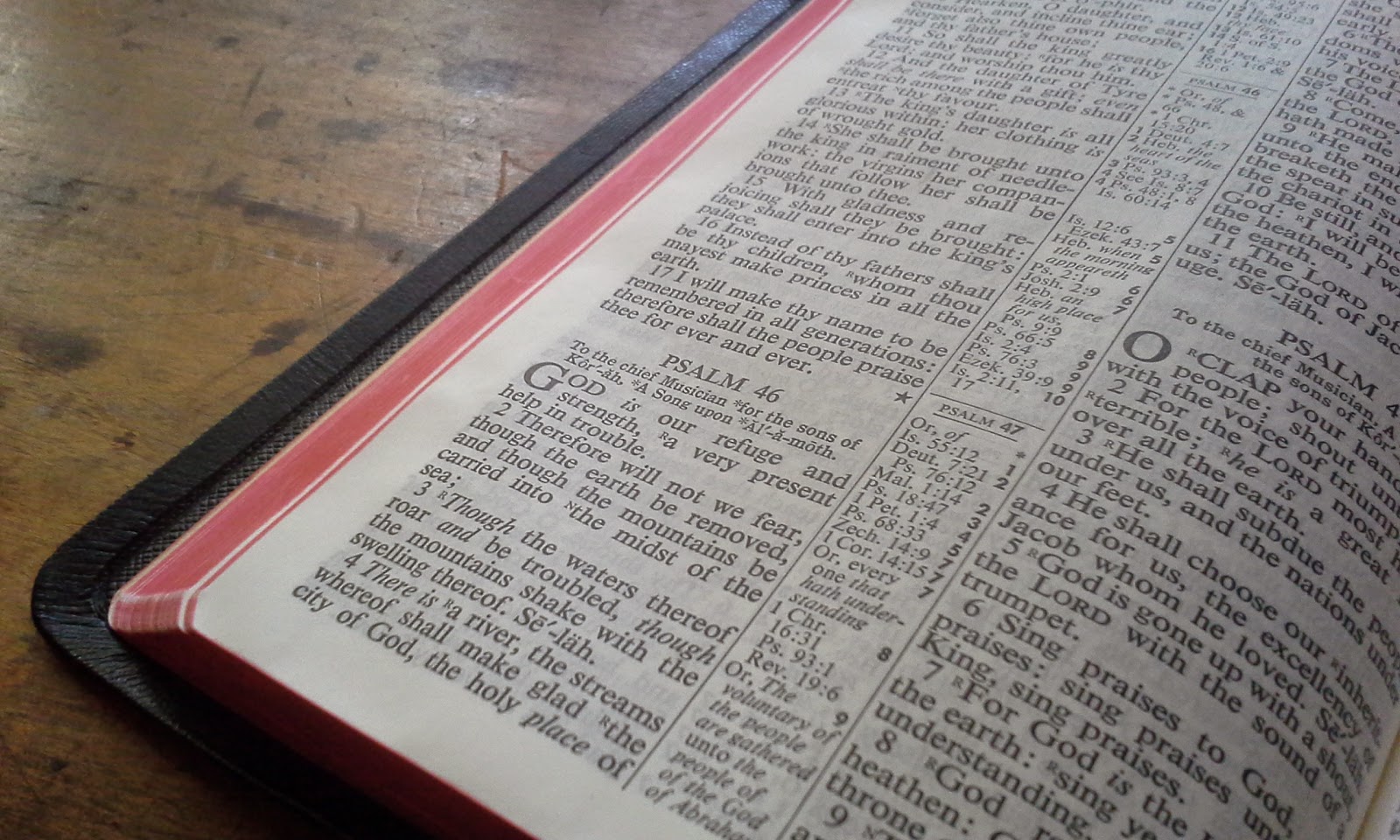
Some vital stats about my journey: I will have completed the KJV Bible in about 24 weeks, assuming I stay on course for the next 7 days or so. This averages about 7 chapters a day. That's a pretty good clip for most folks, and probably faster than I would recommend for others. I used three different physical copies of the Bible (see below). This completes the third translation in which I have read Scripture in its entirety. 

Moreover, here are a few of my gleanings from this venture:

1. Regret. If I could live my life over, I would not have waited this long to throw myself into the King James. This should have been done long ago. For those who have never tried this, do it now. The AV is a treasure that has been passed down to us from many stalwart Christians and we owe ourselves the favor of reading the English-speaking world's only truly dominant translation.

2. Beauty. I was often struck by the sheer majesty of the text. Many complain about the ubiquitous "Thee's and Thou's." Get over it. It's not that hard. Reading the text with these ancient pronouns does seem to have a positive affect on the reader's awareness of the divine, especially as he reads the Psalms and prayers of Scripture. Calling God by a pronoun that is no longer in common use (such as Thou) does seem to me to have the affect of setting Him apart, in the same way as capitalizing "Him" or "His" does when I refer to God in writing.

3. Challenge. I started off reading the KJV like a ball shot out of a canon. Much of my 7 chapters per day average came in the beginning as a I read eagerly and voraciously. I did begin to struggle mightily in some of the places that you might expect: kings, name lists, sacrifices, and temple descriptions. I feel that I glossed over too quickly on quite a bit, in the minor prophets especially, that I should try again to recover sometime.

By the time I got to the latter stages of the OT, I literally couldn't wait to get to the New Testament.   I was frustrated that the King James Version made many passages obscure to me, and made them seem as if I had not read them before. Not in a "fresh" way, but in a disappointed-in-myself way. I should have slowed down and focused more on comprehension.

At the same time, I was so excited to meet Jesus again in the words of the KJV! So yeah, getting through the whole OT was a challenge.

4. Joy.  By the time that I finally got to the New Testament, I was again reinvigorated for the project. In fact, when I got to the NT, it slowly became less and less obvious that I was reading a translation that was "foreign" to my experience. It did not seem foreign to me at all anymore. I often completely forgot that I was even reading the KJV, as it all felt very comfortable, familiar, and enjoyable to me. The Gospel narratives were particularly familiar and the story line of redemption history carried me right to the cross.

As I finish out the KJV in the coming days with the prison epistles and writings of Peter and John, I can't help but thank God that He commended such a translation into the hands of the English speaking world. The KJV is timeless, beautiful, and accurate. If you would like to take this journey too, I urge you to begin on your own time and do so on your own pace.

Tangibles - A Good Bible. 

I think a good Bible is a necessity, and I have written on this topic before.

For this project, I actually acquired three new KJV's for usage. (I didn't even own a good copy before. *Blushing*). I kept these three Bibles in various places (office, home, travel) so that I always had one about me within arm's length. I can recommend a couple of good ones that are well made and durable.

  1. Local Church Bible Publishers makes some of the best leather, sewn AV's you can find. They are a KJVO company, so don't expect to get an ESV there! I ordered the Cowhide #355 and loved it. It was only $35. This is an incredible KJV for the price.
  2. Cambridge too makes many good editions. The should! They are the oldest continuous Bible publisher in the world. I used their Split Calf Concord reference model which was given to me free for the "price" of simply doing a review of their books. Being a blogger and product reviewer doesn't hurt!
  3. Finally, I kept a Trinitarian Bible Society Windsor in my office and read it at least twice a day during my office hours. That too was around $35 and paid for itself in devotional sweetness.


-Matthew Everhard is the Senior Pastor of Faith Evangelical Presbyterian Church in Brooksville, Florida.

Tuesday, September 2, 2014

Going Old School: My Venture into the Greatest Literary Work Ever Written in English, The King James Bible of 1611

I'm embarrassed to admit it, but it's true.

At 37 years of age, having been a Christian for nearly 25 years, and having served as a pastor in two Presbyterian churches,  I still have not read completely through the King James Bible.

Cover to cover.

I've received two degrees in theology and am working on my third and final one. But still that fact hangs over my head. Yes, I've read dozens of Psalms and portions of the Gospels in the KJV. But Genesis to Revelation, no. (Hangs his head in shame). As to the Authorized Version, I am still a newbie.

When I was converted to Christ at age 12, well meaning Christians told me to stay away from the KJV. That it was "old fashioned." That it was "too religious." That I wouldn't understand it. That I needed a personal relationship with Christ and that a modern English translation was best. I'm sure they meant well. (Shrugs shoulders).

For years, the NIV84 served as my everyday Bible. My first year as a Christian, I read the Bible straight through. And then I did it again. And again. The NIV84 was my heart language.

When I began to study the original languages of Greek and Hebrew in college and seminary (I got pretty good at the former and still stink royally in the latter), I eventually realized that I needed a more literal, word-for-word translation of the Bible. Thus, the ESV came into my life in the mid 2000's. I latched on and never let go.

Since that time, the ESV has been my translation of choice. Literal, beautiful, authoritative, and powerful, I even led my church through a transition from the NIV84 to the ESV when we purchased all new pew Bibles. The ESV has been the translation upon which I have preached some 500 sermons, messages, and Bible studies (give or take a couple hundred). The ESV has been the text I quoted in all of my books.

But this year, I am going "old school." I turn 38 next month and I am preparing for a new venture in the world's greatest literary work ever written in the English language (and yes, I've heard of Shakespeare and I'm not backing down on that claim).

*Note: I'll still be using the ESV in church. 

Briefly then, here are four reasons that I am starting this personal adventure.

1. The KJV is an excellent, word-for-word translation of the original tongues. Always has been, always will be. It is known for majestic style, accuracy, power, and beauty. Just a couple weeks of studying Greek and Hebrew, and even the seminary freshman can see how fitly the KJV renders the original languages into gorgeous English. The translators of the 1611 masterwork did great diligence and got it right. Pretty amazing for a committee! 

2. It's not as hard to read as everyone makes it out to be. Go ahead and try it out on a Psalm or two. Read a chapter of Matthew or Luke. Compare what a passage in Romans says to the ESV or the NASB and you will see that it's not too terribly difficult at all. The beauty of the text will make up for any strange vocabulary that you will encounter. ("Peradventure?" Had to look that one up!) The oft-cited "thee's and thou's" are actually very beautiful and lend themselves to prayer very readily and naturally. The more you read it, the more you get used to it.

3. History. The KJV was the Bible of Jonathan Edwards, Charles Spurgeon, Billy Graham and virtually every other significant figure between the 1600's and the 1900's. Nearly the entire Puritan and Colonial Calvinist movement used it. For me as a lover of history, this is a pretty significant reason. In the case of Edwards, who is my doctoral research subject, I felt compelled to throw myself into the study of his Bible as well as his thought, theology, worldview, and philosophy. We are not the first generation of Christians on Planet Earth (despite what cutting-edge coffee shop pastors in skinny jeans and horn rims might lead you to believe) and it is a rich experience to read the texts, creeds, and confessions of the generations on whose shoulders we stand. How much more so their Bible!

4. The KJV has influenced the English language that you and I speak more than any other book. Simply speaking, it is a literary gem as well as a faithful rendering of the infallible Word of God. It is shocking to consider all the ways that the KJV has become part of our everyday English. Here is an article that shows that quite well. 

In the coming weeks, I will review a couple of high-end copies of the KJV that you can purchase for around $30--both bound in high quality leathers with excellent print quality and paper--to enhance your reading experience. As a general motivation, getting a new Bible every once in a while is a good incentive to launch a new personal study program! (I think a huge adventure like this calls for the treat of getting oneself a little present, don't you?)

Alright. So the launch begins in a couple of weeks. So, who's with me? Are you ready for the KJV challenge?

-Pastor Matthew Everhard is the Senior Pastor of Faith Evangelical Presbyterian Church in Brooksville, Florida. A confessed bibliophile, he loves the works of Jonathan Edwards, the puritans, and old and new Bibles. 

Sunday, August 24, 2014

"Vintage" Bible Review: Circa 1960's World Publishing KJV Bible

World Publishing KJV Bible in Black Morocco Goatskin
Check your grandmother's closet. Look closely at the Goodwill. Examine that next garage sale with special care.

You may have a valuable "vintage" Bible in your possession.

World Publishing Bible; Double Column Setting, Red Letter
Photographed here is a circa 1960's KJV published by World Bible Publishers in Cleveland, Ohio. Once a dominant presence in the high quality Bible publishing industry, World Publishing Bibles can still be found,  but have been long since out of production.

Formerly the leader in the industry, (insiders say some of their work rivals R.L. Allan today), World Publishers eventually sold off their various book, dictionary, and Bible manufacturing businesses to other companies including: Collins (Great Britain), Simon and Shuster, Putnam, Nelson, and Riverside Book and Bible (Iowa).

[See an article on the history of World Publishing here].
World Publishing Bible; Gold Imprinted Spine, 5 Rib Spine

This particular Bible is a beautiful, near-perfect condition double column reference Bible. It is cloaked in black Morocco goatskin, with full, hatched-style, leather interior lining.

I should say at this point, "They don't make 'em like they used to!" (Actually, some publishers do; Allan, Crossway, Schulyer, and Cambridge still make high quality Bibles, but most others don't even come close).

World Publishing Bible; Leather Interior Lining, Hatched Style
Like all good Bibles coming out in the 1960's this one is Smyth sewn (stitched signatures, groupings of 32 pages), and printed on India paper, the best technology available at the time. (Surprisingly, I could not find a publishing date anywhere in this beautiful little volume). The relative whiteness of the paper today after more than 50 years attests to the quality work that World Publishing Company was doing in that era.

For my part, the paper in this book feels magnificent. It is rich, smooth to the touch, and sturdy. The India paper of that era seems to exceed the much cheaper "recycled" feel of many publishing works today, likely due to our obsession with staying "green." A publisher today may feel that it is more of a credit to their corporation to use recycled (or partially recycled) paper for public relations purposes than to use good, new, paper for high end productions. Pressures to incorporate recycled paper into their Bibles may be the partial cause for the weak and easily staining paper of today's Bibles.

World Publishing Bible KJV; Circa 1960's, Cleveland Ohio
Sadly most Bible publishers began in the 1970's to produce much cheaper, and far less quality Bibles. Many today are glued (instead of sewn), and worst of all, are tucked inside a cardboard cover, or even "bonded leather" (which is really just scraps, leather dust, and glue--the "plywood" of leathers).

World Publishing Bible; Center Column References
This gorgeous, hand-sized edition (measuring at 7.5 X 5.25 inches) of the Authorized Bible has red-under-gold edge gilding to make the pages really "pop" when opened, and glitter when closed. It utilizes one off-center black ribbon, just left of middle.

As for the Morocco leather, it is very flexible without being wimpy, and has been marked by just one notable battle scar in these five-plus decades. Then again, because it is goatskin, it could be original to the hide of the animal.

As it came to me, still in the box, with its original "owner care" papers in tow, I can't say that it ever endured much hard labor from its previous owner. It's only notable weakness is some very slight page warping due to many years of life here in the humid South. I smooth it with my fingers along the crease and it settles a bit, but I doubt that problem is going away soon and is probably related to its age.

World Publishing; Bible Care Instructions
Inside, the text is set in two very readable columns, with references and some annotations in a center column. Words of Christ are printed in red. The red lettering, by the way, is RED. It is not the faint-hearted pink that seems to wilt on the pages of others I have seen.

Extras inside include a substantial concordance, color maps, and a "Bible Reader's Aids" section edited by one Rev. Charles H. H. Wright D.D. of the Universities of Oxford and London. Presentation pages for matrimony, births, marriages, and deaths are set in between testaments.

This Bible came to me with several documents in the original box including "Your World Bible and How to Care for It" (pictured), a certification that the leather is hand-grained Morocco goatskin, and "An Important Note about Gilded Edges." All of this shows me that World Publishing knew what it was giving the buyer--a Bible meant to last.

I want to thank the anonymous giver who handed this over to me several months ago. Honestly, I didn't even know what was in my possession until I began to research it.

So do just a bit of homework next time you are at a your church yard sale; you just might discover a vintage era World Publishing Bible.

-Matthew Everhard is the Senior Pastor of Faith Evangelical Presbyterian Church in Brooksville, FL. Besides being a published author, he is an admitted Bibliophile and an active Bible collector. 

Friday, June 27, 2014

The Joys and Possibilities of Open Space: A Review of the ESV Wide Margin Reference Bible by Crossway

ESV Wide Margin Reference Bible
When I opened the box containing the new ESV Wide Margin Reference Bible, I was awestruck by all that clean, wide-open space. Broad one-inch margins surround the text of Scripture in all directions like a snowy meadow. That vast landscape surrounding my favorite Bible translation prompted three nearly simultaneous thoughts:

What possibilities! 

What an opportunity! 

What in the world am I going to write in those margins? 

Before I provide a technical analysis below of the beautiful setting of the ESV Wide Margin Reference Bible (hereafter: WMRB), let me dream for a few moments about what can be done with an edition of the Scriptures that is set up for copious note taking.
ESV Wide Margin Reference Bible: Brown Trutone Cover

Obviously, the wide margin design is purposefully geared towards those who want to actively record thoughts, observations, and otherwise interact with the text before them. Some of my first ideas were obvious. I could use it for sermon outlines! But then again, I'm more of a full manuscript preacher. Certainly one could use a Bible like the WMRB to take notes during church. But since I'm a pastor, I don't sit in the pews but a few times a year.

So I dreamed bigger. Here are a few of my best thoughts and brainstorms so far...

1. Personalized, One-of-a-Kind, Study Bible. Since I am in a doctoral program at Reformed Theological Seminary, I could use a Bible like the WMRB as my everyday Bible for the course of study in which I am engaged. As a doctoral student, I have the privilege of studying under some of the best scholars in the world. Since I am still early on in the degree and my dissertation reading is still dawning, why not use this Bible as the indelible chalkboard on which my mind is shaped for the next three to four years? I think anyone entering a formal course of Biblical or theological study should consider having a Bible expressly devoted to his accumulated knowledge. I wish I had done that much earlier in my formal studies.
Wide Margin Reference next to ESV Personal Reference Bible

2. Mission Trip Bible-Journal. When this idea struck me, I sorely regretted that I didn't have a Bible like the WMRB back in 1999 when I spent six months in the jungles of Equatorial Guinea in Africa. I could have used it as a veritable prayer journal to amplify my devotions, record names, and intercessions for those people groups I came to love. It could have become a verbal image gallery of my memories of living and serving in the third world.

3. Family Heirloom. As a father of three, I am in the stage of my life where I am thinking about legacy. How do I pass on my accumulated knowledge, my moral compass, and my doctrinal convictions to my children? I could use a Bible like this to record my learning experiences right next to the texts of Scripture that God impresses on my heart. Prayers for each of my children written in the margins could become like a living commentary of their Christian heritage. Again, if I had started earlier, what a treasure I could have written into those margins! New moms and dads should consider this early on.

4. I could take this Bible to Israel next year for our trip to the Holy Land. Imagine having an edition of the text like this just to record thoughts and ponderings about the land in which Jesus lived, taught, died, and ultimately rose. As I travel from city to city next March--from the Galilean hills to Jerusalem itself and finally to Mount Calvary--I could take as many notes about the hills, seas, rivers, landscape, horizons, and sunsets as my little hand could scrawl. If I could draw (I can't!) there's room for sketch making. What a valuable treasure it would be for the rest of my life to look back on my firsthand descriptions of a journey to the topography in which the drama of redemptive history unfolded.

What do you think? How would you use a wide margin edition? Add your ideas in the comment section below!

***

Technical Review
ESV Wide Margin Reference Bible: Brown Trutone

As with the last Bible I reviewed from Crossway, the WMRB is truly a magnificent production. The paper used is quite nice, but unfortunately, not as stunning as the ESV Single Column Legacy. I've never seen anything like that before or since. Nevertheless, it does not feel cheap like gift paper. It's crisp. It has some substance to it.

The line matching technology now used regularly by Crossway, and present in the WMRB, makes that annoying "ghosting" effect minimal. By placing the text on both sides of the page exactly in line (as much as possible) the effect is very noticeable: a cleaner, whiter appearance. Very little show-through. If you've never owned a Bible with line matching before, you probably don't know what you are missing. If you have, you'll never go back to mismatched line printing again!

The binding is Smyth-sewn in the WMRB, meaning that this edition will not fall apart in clumps, since it is not held together by glue. It signatures are sewn together with thread making this Bible durable under modest to high stress such as packing and unpacking regularly. This will ensure that a Bible like the WMRB has longevity--especially if it is going to be toted around the world or passed on as I suggested above. I was particularly impressed with the limpness and flexibility of the binding right out of the box. Open flat to Genesis 1:1 out of the box? Check! It won't take long to break this puppy in. It already came ready to use.
ESV Wide Margin Reference: limp and limber out of the box. 

The two column format is pretty standard, but with one variation--the reference notes are placed on the bottom of the right column instead of the inner or outer margin. I will have to get used to that. I do like two column setups. For some reason, I can remember where passages are in the Bible better than in single column editions. I think that is because the brain has more "locations" in which to store the text I am trying to recall. Interestingly, science is now confirming that we do learn better with 3-D spatial materials such as books rather than 2-D screens.

The cover I received is the brown Trutone. Honestly, it's gorgeous. Some folks are high quality leather only people. I understand the goatskin obsession. I have some of those. But I must say this is one of the best Trutones I've seen. It looks rich, dark, and feels sturdy. It has some moxy to it, in a good way. I doubt this cover is going to flake or fall apart anytime soon. At 9.25 X 6.5 this is a large Bible.

I love the fact that Crossway resisted the urge to stamp some kind of logo or design on the cover as they do so many other editions. I think it looks manly this way. Like it has some bravado. The stitching around the edges is enough to make the financially responsible Trutone "imitation leather" stand up without shame next to a high quality Bible cover.

Now that I mention quality leather, this actually might be an edition that you would want to pop for the high quality lid.

--Matthew Everhard is the Senior Pastor of Faith Evangelical Presbyterian Church. He is an avid reader of the Puritans, a big fan of Jonathan Edwards, and the author of Hold Fast the Faith: A Devotional Commentary on the Westminster Confession of 1647. 


Monday, June 23, 2014

Put That Digital Device Away! Crossway is Making Bibles Better Than Ever: A Review of the "ESV Personal Reference Bible"

The ESV Personal Reference Bible features line-matching technology.
While more and more folks are pulling out their smart phones or tablet devices during church, Crossway is quietly perfecting the art of the written page.

The current generation of Bibles from Crossway are intentionally designed to help believers rediscover the aesthetic beauty of holding and reading well-made books. Among the features of Crossway's new Bible lineup is a technology called "line-matching" which helps ensure that ghosting (that annoying see-through in Bibles' thin pages) is minimized.

Line-matching uses digital printing technology to ensure that--as much as possible--the Biblical text is printed exactly in line on both sides of the page, thereby making the page look whiter and cleaner. At the same time, Crossway is also using better and better paper too, toeing a difficult line between the thinness and opacity required for printing Bibles with thousands of pages.

In this review, I will be looking at a great example of this generation of affordable Bibles from Crossway: the ESV Personal Reference Bible. This is an ergonomic, hand-size Bible which ought to justifiably displace that distracting digital device that so many are using today.
The ESV Personal Reference Bible (top) with ESV Wide Margin (below)

Review: The Personal Reference Bible (Trutone, Mahogany, Emblem Design)

In this review, I will look at several of the main features of the ESV Personal Reference Bible (hereafter, PRB) including: format, cover, binding, paper, and features. I will not be doing much with the translation, because I have already argued in other places of the ESV's excellence. That will be assumed already in this review.

Format
The ESV Personal Reference Bible is comparable to the Cambridge Clarion
The PRB is a very delightful size and the "form factor" is just right for tucking in one's briefcase or purse and toting along to church. The text block measures at 5 X 7.4 inches, and when open, fits perfectly in the hand. The font size of 8pt. is very stark considering its portable size. The PRB comes in a single-column format making it eminently readable, especially in poetic sections, which are not rudely cut off as so often occurs in double-column settings. The PRB has the standard 80,000 cross-references which seems to be pretty across-the-board in Crossway's reference Bibles. These references are placed in the center near the gutter and do not detract the eye from reading smoothly across the whole page.

All of this means that the PRB is a much more financially responsible version than more pricey high-end competitors such as the ESV Cambridge Clarion. In fact, if you have been Jonesin' for a Clarion, but cannot force yourself to spring for their pricey high-quality covers ($136 for the calf-skin or $150 and up for the goatskin), you might consider the PRB a cheaper, but trusty and reliable alternative.

Of course, you won't get a goatskin with this $15 PRB either, and that brings me to...

The Cover
The version that I am reviewing is the Trutone in deep mahogany with an emblem design. This Bible also comes in calfskin, (Crossway calls it "top grain leather") but that is going to jump the price to about $110. Since I am writing today for the common man or woman in the pews, I am not sure that a high price cover is even necessary.

I have owned several of Crossway's Trutone covers before on my ESV's and they have all lasted well. These synthetic covers look good and feel real-ish to the hand. I wonder if some people even realize that they are not leather? The truth is that both goatskin and calfskin really are much more aesthetically pleasing. (Trust me, I just had a Bible recovered from Leonard's!). But if the purpose of the cover is to protect the contents and attract the eye then the Trutone will not disappoint.
Many will love the mahogany emblem design; I prefer plain, natural looks.

As far as I know, Trutone is a synthetic material made from some durable and flexible polymer. Honestly, I haven't done the research to know for sure what they are made of. What I can tell you is that they are getting better and better all the time.

They are much more like real leather in both look and feel than earlier generations, which tended to peel and flake under severe duress (such as sunlight and aging).

The mahogany color of this version is beautiful. Personally, I really wish they would have left off the emblem (rose pattern) from the cover, but I can tell you that my wife and twelve-year-old daughter both oowed and aawed when they saw it, so perhaps it is a male/female thing. Personally, I like my Bible covers to be dark, manly, and natural. Thankfully, the emblem is not embossed with any coloration and disappears in darker lit rooms below the deep, rich color. Several other cover varieties are currently available as well.

Binding 
Most readers are not even aware that their Bibles are bound in vastly different ways. They are. It makes a huge difference.

Crossway is now using Smyth-sewn bindings on almost all of their Bibles, if not the entire lineup. This is the best possible strategy for binding paper together; far better than "perfect bindings" which merely glue stacks of loose sheets together. In Smyth-sewn bindings, the signatures (groups of 16, 32, or 64 pages) are folded, sewn together, and then stitched together as a solitary unit. For this reason, they hold together well and last much longer.

A good binding will do two things. (1) It will assure that your Bible does not fall apart in clumps as aging, glued books inevitably do and (2) it will allow the Bible to open flat, flex naturally, and stay open without snapping shut like a bear trap.

I am sure that all pastors and Bible students have struggled with a Bible that wants to snap shut every time one moves his hands to type or take a note. Not here.
The ESV Personal Reference Bible (top) perfectly portable!

While the PRB did not open completely flat to Genesis 1:1 out of the box (a litmus test for excellent bindings), it did do rather well by opening flat to Deuteronomy. Not bad.

After pressing the binding open and flat with my hand every 50 pages or so (as one ought to do with a new book), the binding greatly improved in flexibility after just one day.

One small complaint that I would have here in this version is in regard to the inner lining (the material used to attach the text block to the cover material). In the PRB, it is merely composed of a thicker paper, almost like very thin cardboard or something. Other Crossway products are a bit better, using a glossy and more durable material which is water-resistant.

Time will tell if this -thickpaper lining will be the Achilles heel of this particular Bible. I could foresee the liner being a possible location in which hard and rugged use causes a rip or tear. Then again, I keep reminding myself this Bible can be owned for only $15.

Paper
The paper used in the PRB is good. The line-matching makes it appear great. I will confess that it is not nearly as good as that used in the ESV Single-Column Legacy which is the best Bible paper I have ever seen and held in my own hands. Ghosting is minimal, and print quality (evenness of the darkness and clarity of the text) is very good. In some Bibles, the super-thin paper nearly ruins a great version. Not here. Solid work, Crossway.

But why not use the Legacy paper in all of your Bibles?

The pages are gilded with gold edging finishing the look. Some of my Bibles have flaked and scratched considerably along the edges. I don't think that is something that can be improved, though. The page ends tend to receive a tremendous beating when a Bible is used for years, being the physical location of much finger shifting, grabbing, and turning.
The ESV Personal Reference Bible (R) vs. Wide Margin (L) size comparison

Features
If you love this Bible as much as I do, it won't be because of its features. It doesn't have many. No one is going to mistake this little gem for the ESV Study Bible!

More likely, it's simplicity, readability, and portable size will be the endearing features for you as they are for me.

The PRB does have a rather nice concordance, and a beautiful matching ribbon. (Two would have been better). The gutter-side references are convenient and pleasing to the eye. A presentation page will mark the date and occasion of the receipt of this Bible, and I do think that at the price of between $15 and $22 this will make a great gift Bible or travel Bible. It may even become the everyday Bible for some folks who don't like to tote a brick like my ESV Study Bible around town!

Overall, the hand-held portable size and readable font will make sure the PRB is treasured for many years by the owner. With nice publications like this coming out from Crossway, I can't imagine why anyone would want to use their phone in church anymore!

--Matthew Everhard is the Senior Pastor of Faith Evangelical Presbyterian Church in Brooksville, Florida. He is the author of Hold Fast the Faith: A Devotional Commentary on the Westminster Confession of Faith and several other books. Matthew frequently does reviews of theological works, Bibles, and other Christian publications. 
Thursday, May 29, 2014

Bible Stories: An 1814 Edition of the Scott's Reference King James Bible

1814 Scott's Reference Bible (KJV)
In a previous post on the aesthetic beauty of Scripture, I reviewed one of the most excellent, high-end Bibles on the market today, an R.L. Allan. Here, I want to share about an edition of the Word of God that has come into my possession that is of an entirely different sort, the 1814 Scott's Reference King James Bible.

It is an appropriate time to write this piece, as this heirloom in my personal collection is now in its bicentennial year. At 200 years old, it is the grandfather of the many and various Bibles that I possess on my shelf.

This grand book came to my possession as marvelous gift. A couple of years ago, an elder at my church, Karl Baldner, gave me an unexpected gift. In the box was a typed note which read,
To Matthew Everhard, Christmas, 2010
This Scott's Reference Bible, was given to me in 1953 upon my ordination to ministry, by the last person ordained in my local church, Morris Ikenberry. Morris was a lay preacher, who taught, or tried to teach me in Sunday School when I was a kid, and about as ancient as I am now, 76. He received this book from his grandfather who also had been a lay preacher. It, as you will notice, was printed in 1814, making it 196 years old. For a number of years I have been looking for someone I loved and respected, whose ministry showed great love, caring and humbleness for his flock; whose spiritual gifts were many, and from God, including the gift of opening the church front door and welcoming in the sheep and goats. You are the one I have chosen to give this book to. I hope it reminds you of the eternal gift of the Gospel, that has existed all these years, and will continue to exist after you and I, and this book return to dust. May God continue to bless you, your family, and your ministry. -Elder Karl Baldner
(I should say that if you don't know Karl Baldner, you might not have picked up on his subtle sense of humor. He often reminds me that opening the church door is the ONLY real spiritual gift I have. Karl is a Mennonite-turned-Presbyterian who was a pastor and church planter long before church planting became "cool.").

Inside the Bible, there is another inscription, more haunting still,  from an unknown hand which reads in beautiful cartography,
Within this awful volume lies  
The mystery of mysteries 
To read, to hear, to watch, to pray 
To raise the latch and force the way 
But better they had ne'er been born 
Who reads to doubt or reads to scorn (1)
It certainly gives the reader pause and bids him to consider the eternal weight of the contents inside, doesn't it? Now, a bit about the construction of the Bible itself.

Hand-written inscription in the 1814 Scott's Reference Bible
First, it's exterior. It is bound in leather on board. The spine boasts four raised ribs and the placard reads "Scott's Reference Bible" in gold embossed on black.

For those of you who may be Bible Design Blog fans, this is one of the beautiful antiquated styles that is often replicated by quality book rebinders such as Leonard's Books, who is now emulating these older fabrications with great beauty.

The Scott's Reference Bible with much younger companions. 
As cited above, the version is an 1814 printing of the study Bible edited by Rev. Thomas Scott, D.D. whom the title page denotes as the "Rector of Aston Sanford, Bucks, and Chaplain to the Lock Hospital." The volume was printed in Philadelphia by William W. Woodward, by Griggs & Dickinsons, Printers. A quick Google search revealed that Rev. Thomas Scott was a dear friend of John Newton (the author of the great hymnn Amazing Grace). Scott was a pastor ordained in the Anglican tradition, as well as a hospital chaplain who ministered primarily to syphilis patients. His Commentary on the Whole Bible as well as his The Force of Truth gained him international recognition.

Its dimensions are quite large. It's not a full "Family Bible" size, but it is clearly not a pocket reference edition either. It's dimensions are 9.5 X 6 inches with a spine girth of 3.75 inches meaning that it probably resided on the study desk of the four generations of pastors (at least) that have owned it.

1814 Scott's Reference Bible title page and publisher info.
Inside, the text itself, the Authorized Version, is printed in two columns with both center and edge references. With both the gutter and edge margin filled with Scriptural references, the text block is stocked with useful information, perfect for a pastor laboring in the pre-Biblegateway.com days!

As often as is feasible, the column references attempt an estimation of the date of the context of the Scripture text. For instance, Genesis 1 is noted as pertaining to 4004BC, events surrounding the exile are thusly noted, and the events of the New Testament are given a corresponding date, anno domini. Not only is each book of the Bible given a rather sturdy introduction considering it is really a reference edition (in minuscule print), but each chapter too contains a brief introduction of at least a good, full paragraph. For this reason, this edition might be considered a very old predecessor to the ESV Study Bible to which it is comparable in size.
Scott's Reference Bible, double column, dual margin references.

The pages retain the aged musty smell of a book that has soaked up the fragrances of many and varied homes and bookshelves. Perhaps a cigar-smoker or two once owned this book, although it wouldn't be from its later Mennonite owners! One red blot on the spine says that at some point it had a close encounter with a can of paint. The squared pages are now so stained by the natural elements and aging properties of paper that they are nearly as dark as the chocolate leather.


One day, if the Lord should tarry, I hope to give this Bible to the next pastor down the line who endeavors to carry the enduring Gospel in his own generation.

-Matthew Everhard is the Senior Pastor of Faith Evangelical Presbyterian Church in Brooksville, Florida. He is the author of several books and many articles, as well as an acknowledged bibliophile. 

(1) A version of Sir Walter Scott's poem. The unknown penman omitted verses 3 and 4 which read, "O happiest they of human race/to whom our God has given grace."