Monday, July 22, 2013

Remember Your Leaders

Who you are today is a reflection in some part of who has been a leader to you. Fundamental to the building block of life is learning from leaders in our lives. When we were children we learned what it mean to be human by copying the ways of our parents (i.e. walking, eating with utensils, learning how to speak, etc.). As adults we learn how to be successful in a new job by watching those who are successful in our field. We are who we are in many respects due to those whom we have followed in our lives, the leaders whom we have looked up to.

photoWho is a Leader Worthy of Following?
The Author of Hebrews knows this reality, that we are followers. He knows that we are people who learn from others, particularly the leaders to whom we aspire to be like. And so Scripture, in God's wisdom, wholeheartedly affirms that we are to be a people who continue to learn in this manner, by imitating our leaders. Hebrews 13:7 charges the reader clearly to this manner of life: Remember your leaders, those who spoke to you the word of God. Consider the outcome of their way of life, and imitate their faith. We learn two things very quickly from this passage:
  1. A leader is a particular kind of person, someone who spoke the word of God to you. We are to remember those leaders who have led in such a way as to lead us to the truth of God in His Word. According to Scripture, a leader is one who leads others to God.
  2. A leader is someone that we are imitate. A leader who leads others to God will have a life that reflects this conviction. They will be people whom we should therefore imitate; they are leading by example of what it means to be a Christian. The shepherd image in the NT calls them to be examples to the flock (1 Peter 5:3b); they are shepherd-leaders whom we are called to imitate.
Leaders to the World vs. Leaders to God
The exhortation then is for us to imitate the lives of those whom have led their own in a manner that reflects the calling of the Gospel. We are not meant to follow the leaders that the world portrays as leadership material, for very few of them lead us to God. They instead lead to fame, fortune, success, and pleasure. God's leaders take our hand and show us how to live in humility, as a servant, in love, and in devotion to God. God's leaders are very different from the world's.

Remember Your Leaders
Therefore to obey this verse means that we to imitate the lives of those who lead us in Truth. But in order for us to do this we must begin with the first three words of the verse: Remember your leaders. We must remember those in our lives who have led in a Godly manner, those who are worthy of our imitation. It is the calling upon the Christian to remember those who led us, to remember those who taught us regarding God's grace in Jesus Christ, to remember those whom we have read whose wisdom has brought us thirsty for more of God. Therefore over the next few weeks we will looking at particular leaders of the Christian faith who are worthy of our imitation. They will be people whom we can learn from, whose lives have sounded forth a deep relationship with God. Our call is two fold: 1) to imitate Godly leaders, and 2) to first of all remember them. We cannot imitate if we don't know who it is we are called to imitate. There are people who have proved worthy to follow, people who have led many to Jesus. Our task in the coming weeks is to remember these leaders.

**Next Week: Remembering Your Leader Jesus

Friday, July 19, 2013

Don't Open That Commentary (Yet!) Twelve Basic Questions for Biblical Interpretation

Some of my best friends are dead. But don't send me flowers just yet. I mean that some of the people that have impacted my life greatly are the Biblical scholars, theologians, and commentators who have gone before me in generations past. 

I cannot underestimate the value of a good commentary on the shelf of a pastor (or better yet, laid open on his desk!) 

But before we just head straight to the wisdom of the scholars, any diligent student of Scripture can do the work of Biblical exegesis on their own. True, our learning can be greatly enhanced by our Biblical reference tools (they are virtually unlimited online today). But that doesn't mean I can't (and shouldn't!) do some heavy lifting of exegesis myself. 

If you are responsible for teaching the occasional adult, youth, or even children's Bible lesson (or even if you just want to improve your own personal devotions) here are 12 good questions we should ask of any text we are examining:
What is the author’s central or main point in this passage?

Why does the author include this material?

Why is this material placed here in the book, rather than in another location?

What comes immediately before or after this passage that may help explain it?

What words, customs, places, or practices in this passage need to be explored?

How would the original hearers/readers have been moved by this passage (gladdened, surprised, offended)?

What response(s) is the author trying to elicit from his readers by including this material (i.e. conviction, fear, joy, dread, obedience, repentance, evangelism etc.)…

What other passages or parallel texts might highlight themes or motifs similar to those in this passage?

Is the author drawing from other literary sources (such as the OT)? Why does he use them?

What does this passage teach about the nature of God? The condition of man? Of Christ?

What major doctrines are to be found in this passage?

What apparent contradictions (if any) may need to be resolved?
Finally, I'm ready to ask: What light do the commentaries shed on this passage? 

--Matthew Everhard is the Senior Pastor of Faith Evangelical Presbyterian Church in Brooksville, Florida.  

Thursday, July 18, 2013

Justification and Indulgences?

Can we earn our forgiveness with God? For many centuries of the Christian church, the issue of how we are saved from our sins and reconciled to God has been center stage. The term the church has used to describe one’s salvation has been justification. The term implies a legal reckoning, that there has been a breach against certain laws which a person was required to keep. Due to Adam’s sin in the garden humanity is now seen by God not as righteous, but as sinful and wretched living in open rebellion. God therefore instituted the covenant of grace in His Son Jesus Christ and His work on the cross for humanity. The death of Jesus Christ provides the opportunity for justification before God, for our sins to be wiped clean and a verdict of righteousness given to us. How then does this justification take place, is it earned?
Luther, Pope Francis, and Indulgences
martin_lutherIn the 1500′s, a German monk named Martin Luther took this question on in full force. He bucked the answer that the Catholic Church church gave and thereby defied the most powerful institution in the world. The Catholic Church, under the leadership of the Pope, held as orthodox that salvation is obtained not entirely by God’s grace, but instead may be earned by works on our part. Chief example was the widespread practice of indulgences, an assurance that one could purchase for themselves or a loved one that ensured their salvation. Just yesterday the current pope (Francis) continued this practice of indulgences, promising those who follow him on Twitter will be recipients of “indulgences.” In response to indulgences, Luther wrote his famous 95 Theses on October 31st, 1517 (a date often referred to as the beginning of the Reformation) as a vehement rebuttal of the theological abuse the Catholic Church was practicing. Luther says:
Indulgences are most pernicious because they induce complacency and thereby imperil salvation. Those persons are damned who think that letters of indulgence make them certain of salvation…His Holiness abuses Scripture…I deny that he is above Scripture. 
                                                     Roland Bainton, Here I Stand, 63.
Justification by Faith Alone
Luther instead insisted that our theology of justification be based upon the Word of God alone. He came across passages such as Ephesians 2:1-10 (for by grace you have been saved through faith) and cried “foul!” The clear means of justification to Luther according to God’s Word was that it happened by faith alone, through grace alone. Justification was not a by product of something that we merited, something that we earned by either being good (which would do nothing since the law was already broken) or by purchasing indulgences which promised salvation (though no such authority is given according to Scripture). To Luther and the Protestant Reformers, nothing but the grace of God alone could justify a person and declare them righteous. It had nothing to do with our striving and any such effort on our part was “striving after the wind” (Ecclesiastes 1:14).
While the Reformation was successful in that it instituted faithfulness to Scripture in the Protestant church, there are still many who have yet come to know this glorious reality of God’s grace. It is part of every Christian’s calling to communicate the truth of the Gospel, that it is by grace alone that we are forgiven, that we are justified in God’s sight.  This is the good news of the Gospel, the good news of Jesus Christ, the foundation of our faith.

Tuesday, July 16, 2013

Whitefield's Prayer Welcomes JT Holderman!

I want to take a moment today to welcome a new writer to our panel at Whitefield's Prayer. His name is J.T. Holderman, and he is the new assistant pastor at Bellevue Presbyterian Church in Gap Pennsylvania.

J.T. and I met recently at the EPC general assembly Denver Colorado although we had begun a friendship several months ago through Twitter and other social media. Once we met in person, it was obvious that J.T. was a "Whitefield" kind of guy!

J.T. is married to Kimberly and is an avid mountain biker. 

J.T. is also a graduate of both Princeton Theological Seminary (M.DIV) and Gordon-Conwell Theological Seminary (TH.M) we we know already that he is uber-smart! Welcome to the team buddy!

-Pastor Matthew Everhard is Senior Pastor of Faith Evangelical Presbyterian Church in Brooksville, FL.

Wednesday, July 10, 2013

In Honor of John Calvin's Birthday, July 10th 1509

As today (July 10th) is John Calvin's birthday, I thought it would be appropriate to blog this wonderful quotation from the great Reformer regarding God's incredible sovereignty and astounding power.

This is a fairly representative portion of his magnum opus, The Institutes of the Christian Religion, underscoring Calvin's extremely high view of God:
Although our mind cannot conceive of God, without rendering some worship to him, it will not, however, be sufficient simply to hold that he is the only being whom all ought to worship and adore, unless we are also persuaded that he is the fountain of all goodness, and that we must seek everything in him, and in none but him. 

My meaning is: we must be persuaded not only that as he once formed the world, so he sustains it by his boundless power, governs it by his wisdom, preserves it by his goodness, in particular, rules the human race with justice and Judgment, bears with them in mercy, shields them by his protection; but also that not a particle of light, or wisdom, or justice, or power, or rectitude, or genuine truth, will anywhere be found, which does not flow from him, and of which he is not the cause... (Institutes 1:2:1).

-Matthew Everhard is the Senior Pastor of Faith Evangelical Presbyterian Church in Brooksville, Florida.

Tuesday, July 9, 2013

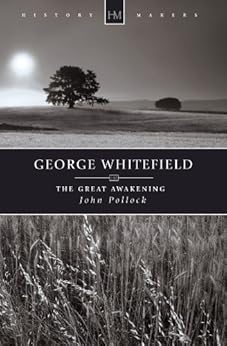
Book Review: "George Whitefield: The Evangelist," by John Pollock

"George Whitefield: The Evangelist," by John Pollock is an excellent introductory sketch of the life and ministry of the famed Great Awakening revivalist.

Pollock has an easy-to-read style that helps the reader coast through the primary events of the life of Whitefield as an up-close eyewitness. The style of this book takes one "behind the scenes" as it were, into the life of Whitefield.

For this reason, quotations are plentiful but footnotes and citations are rare in this book. For some, this is a strength. Polluck is more of a story-teller than a strict chronicler. For others, this may be frustrating as they seek to do further or more in-depth research on the protagonist.

The author clearly has a fondness for Whitefield, often defending him in the midst of his several controversies. At the same time, this work is not hagiography. Polluck is fair and honest with Whitefield's errors (particularly in his youth) as well as forthright about his divisions and contentions with other believers.

I did think, however, that Polluck missed the point in Whitefield's theological dispute with John Wesley (chs. 23-26). Polluck seems to believe that Whitefield thought Wesley a universalist. This likely comes from his misapprehension of the doctrine of Limited Atonement. In this particular episode of Whitefield's life, Polluck seems to lean towards a Wesleyan understanding of salvation, calling the founder of Methodism a much "stronger theologian." Polluck appears to have missed the Biblical force of Whitefield's predestinarianism, and seems to dismiss it as mere foreknowledge. Polluck seems almost embarrassed of Whitefield's unabashed Calvinism and relentlessly dresses it up for the reader.

As Polluck tells the story of Whitefield's evangelical zeal, this reader found himself repenting of my own coldness towards evangelism and personal witness. Whitefield certainly devoted his life to proclaiming the evangel, and I could not help asking for more of the same fire.

That weakness notwithstanding, "The Evangelist" is an excellent and thoroughly enjoyable introduction to George Whitefield.

Matthew Everhard is Senior Pastor of Faith Evangelical Presbyterian Church in Brooksville, Florida.