 |
| Not that there's anything wrong with the Port. |

Sunday, July 8, 2012

Thursday, July 5, 2012
A Review of the 32nd General Assembly of the Evangelical Presbyterian church
By
Matthew Everhard
Last month, Faith EPC of Brooksville sent ruling
elder Gwynn Blair and I as delegates to the 32nd annual General
Assembly of our denomination, the EPC, in Baton
Rouge Louisiana. Delightfully, this was the first time that I also
took my wife and children to the Assembly.
As an event, the G.A. was very well done. Worship
times were Christ-honoring and reverent. The preaching was outstanding this
year. Nothing compares to elders and their families singing gloriously to our
Risen Lord and sharing the Lord’s Table as an entire denomination.
Credit here goes to our Stated Clerk and Executive
Pastor, Jeff Jeremiah, and host pastor Gerrit Dawson and their staffs for
spearheading the event!
Our host church, First Presbyterian Church of Baton
Rouge, did an amazing job in hosting. We were fed “southern style.” I was
particularly impressed with the way that the host church and the EPC
headquarters prepared events for the children. It was wonderful to see my three
kids enjoy fellowship with other “P.K’s” (pastors’ kids).
Growing Pains
The EPC is growing quickly. In the past five years
we have doubled in size from 182 churches when I was ordained to our current
364 churches. This shows the fact that being a part of the EPC, a denomination
that is solidly Reformed in theology and amicable in spirit, is attractive to a
larger and larger number of churches.
Although a bit of our growth is attributable to
church planting (we pray for far more!) the majority of our growth has come
through disaffected churches departing from the increasingly liberal PCUSA. The
theology of the old mainline is regarded by many as a sinking Titanic of sorts,
rent asunder and foundering.
While this may seem as unqualified good news, the
“other side of the coin” is that the EPC is receiving many new churches that are
likely not as conservative as our own congregation. Almost all of these
churches, for instance, have women elders and quite a few have women pastors
(teaching elders) as well.
In our own Presbytery of Florida, for instance, we
have—in just two short years—abdicated our former position of
complementarianism (men elders only) in favor of accepting women elders and
pastors. This change is happening rapidly, and to the chagrin of the elders of
this particular local church.
How dramatically this shift impacts the EPC, only
time will tell. Having said that, let me point out a few other highlights of
the 32nd Assembly…
Missions
The EPC maintains a strong missionary passion. As a
denomination we send missionaries into the 10/40 window regularly—regarded as
the most dangerous places on earth. Our focus as a denomination is on reaching
and converting the Muslim world. While a daunting task, “someone has to do it.”
Let it be us!
We prayed for 37 of our missionaries in the GA.
This was a wonderful moment. I strongly encourage all members of Faith to
obtain one of our World Outreach missionary prayer flip-charts. My family
regularly prays for all of our missionaries in a year, and many of them are in
“sensitive areas” that cannot be disclosed. Our denomination has a plan called “Engage2025” to challenge each presbytery to plant a church in an unreached people
group within fifteen years.
More on Church Growth
The EPC has officially closed the New Wineskins and
National Non-Geographic Presbyteries that were formerly used to bring in new
churches under transition. Now, churches must come directly into established
geographic presbyteries. Anywhere between dozens and hundreds of churches will
be seeking to enter the EPC in the coming months, as the PCUSA continues its
pernicious slide into heresy. Only the Lord knows how many churches will enter
the EPC, and how many will enter a brand new denomination, just opened, called ECO (Evangelical Covenant Order of Presbyterians).
In my view, the formation of ECO is a good thing—it
will serve as a “middleman” between the EPC and the liberal PCUSA. Hopefully,
the more conservative churches will come here and those less so will go to ECO
happily.
Church Planting
The EPC maintains a focus on being “missional” by
intending to plant dozens of new churches here in the US. During the
Assembly, many of our church planters were invited to pray to open and close
business meeting sessions. This brought church planting to the fore of our
denomination’s attention. As expected, each of the church planters had a
miraculous story of how God is moving in their midst! This was stirring to
listen to, as many pastors reported on growth with humility and tears. No
church planting story is ever the same. Hearing about these great moves of the
Lord’s hand only encouraged me to continue to press on as Faith
Church plants Providence Church
in Spring Hill.
Statement on Religious
Freedom
The EPC took a rather unprecedented move in making
a somewhat “political” statement during the assembly. The EPC rarely talks
politics (this is a nice feature of our denomination) but this time, the relevant
issues touched on abortion. We have always stood against abortion as an evil in
our culture. This year, we took a stand for religious freedom by officially
opposing some of the clauses in the Affordable Care Act (otherwise known as
“Obamacare”). This document passed unanimously states in part:
It is the position of the Evangelical
Presbyterian Church that these regulations [mandates to cover abortifacent
drugs, abortion related procedures and services] constitute an
unprecedented overreach by the federal government and an infringement upon
religious liberty and rights of conscience guaranteed by the Free Exercise
Clause of the First Amendment of the U.S. Constitution.
Conclusion
To wrap up, though I continue to have some
misgivings about the quick growth of the EPC through transfer churches from a
much more liberal body, I am optimistic that the EPC remains a solid--if
imperfect--denomination. Our historical moorings to the Reformed faith, and
specifically the authority of Scripture, will see us through many storms of
changing times, if we continue to “hold fast the faith” by building on the
foundation of Jesus Christ. God help us.
Pastor Matthew Everhard is the Senior Pastor of Faith Evangelical Presbyterian Church of Brooksville. Follow him on Twitter @matt_everhard or "friend" him on Facebook at www.facebook.com/pastor.everhard
Anger: A Feast Fit for a King
Throughout this summer, our church has been studying the Ten Commandments in a sermon series entitled, "The Laws of Love". Last week our senior Pastor preached on the sixth commandment, "Thou Shall Not Murder". As he pointed out, if there ever was a commandment where our initial reading would cause us to think that we've at least kept one of them, it would be murder. But Jesus doesn't let us off the hook so easily. In the middle of Jesus' Sermon on the Mount he exposes all of us as murders:
"You have heard that it was said to the people long ago, 'You shall not murder, and anyone who murders will be subject to judgment'. But I tell you that anyone who is angry with a brother or sister will be subject to judgement." (Matthew 5:21-22a)
Ouch.
I've been thinking this week about how often I am guilty of exactly what Jesus is saying. Anger (i.e. the unrighteous kind; we won't go into it in this post, but make no mistake there is in the Scriptures an anger against sin that is commended by God) is a spiritual cancer. It eats away at us in the church as a full-frontal assault on the twin pillars of truth and love, both of which find their foundation in the chief cornerstone, Jesus Christ. Anger can cause us to emphasize one over the other; truth at the expense of love (which is barbaric), and love without its origin in truth (which is much closer to hate). I think Frederick Buechner, a 20th century novelist and Presbyterian minister, said it well. He writes concerning anger,
"Of the Seven Deadly Sins, anger is possibly the most fun. To lick your wounds, to smack your lips over grievances long past, to roll over your tongue the prospect of bitter confrontations still to come, to savor to the last toothsome morsel both the pain you are given and the pain you are giving back--in many ways it is a feast fit for a king. The chief drawback is that what you are wolfing down is yourself. The skeleton at the feast is you.”
Anger is indeed a feast and plays us for the fool. It fools us into thinking we are storing up rage against a brother or sister, or even God, and thus erodes truth because we are only weakening ourselves. And anger destroys our own joy in community and as believers, which is the most un-loving we can be toward ourselves, much less our brothers and sisters. If you're like me, you're tired of feeding this monster.
The great Reformer John Calvin calls us in the church to be "an embassy for reconciling men to God" in his commentary on 2 Corinthians 5:18. Paul had reminded the Corinthians of their identity and mission. "Therefore, if anyone is in Christ, the new creation has come. The old has gone, the new is here! All this is from God, who reconciled us to himself through Christ and gave us the ministry of reconciliation." (2 Corinthians 5:17-18) Anger can be the antithesis of that mission. Notice how Paul tells us that the rallying cry for our ministry of reconciliation with our brothers and sisters is firmly rooted in the reconciliation bought for us through the blood and atonement of Jesus. How much more then is at stake in our ministry of reconciliation? Our anger not only makes us into murders, but it creates spiritual amnesia. We forget our reconciliation in Christ. And we forget the ministry of reconciliation for which He has called us his own.
Lee Hutchings is the Pastor of Discipleship at Highlands Presbyterian Church in Ridgeland, Mississippi
Friday, June 29, 2012
Book Review. "The Life of A.W. Tozer: In Pursuit of God," by James L. Snyder

This work is almost entirely a collection of loose quotations and undated anecdotes from those who knew him best. As such, it tends to read more like a funeral eulogy than a historical survey of the man's life and ministry.
Most of the recollections given of personal experiences with Tozer are general in scope. The author treats the reader to a rather monotonous series of fond memories, invariably beginning with "once," "on another occasion," or "one time..." For this reason, the total work gives the impression of pearls strung together in a loosely chronological but predominantly thematic order.
Very little attention is given to some of the significant moments in Tozer's life: his wedding to Ada, for instance, is treated with little more than two lines. His reception of honorary degrees (Tozer did not attend seminary) is only mentioned incidentally. His relations with other prominent evangelicals (outside the Christian Missionary Alliance which the author highly regards) such as Martin Lloyd-Jones is only regarded tangentially. His theological framework--such as it was--is lightly regarded.
Those accustomed to a more historical, annotated style of biography would probably do well to skip this particular volume on the life of A.W. Tozer, in favor of something more scholastic.
All in all, this book did what it was probably written to do, viz. provide some food for thought holding up Tozer's memorable quotations (already found in plethora in his collected writings) as the center-piece.
Matthew Everhard is the Senior Pastor of Faith Evangelical Presbyterian Church in Brooksville, Florida.
Thursday, June 28, 2012
Psalm 23, Do You Say It in Earnest?, Part 1
Ever since the age of five, my family has visited a
particular stretch of beach located in North
Carolina
Realizing this too common phenomenon, I tried to come up
with a way to help my mind focus on the details of Psalm 23 (the
well-known The Lord is my shepherd passage). John Calvin and Charles Spurgeon,
in their commentaries on Psalm 23, note what an amazing and godly man David was
to have written what he did. I asked myself, When I speak Psalm 23 aloud, in
song or praise, do I speak it in earnest? Or, in other words, How truthful are
the precious words of this Psalm when emanating from my mouth? I admit—sheepishly, may I say—that
I was not all that pleased with my answer to that question.
Nonetheless, this very question will serve as the backdrop
for my next few meditations on Psalm 23, as we walk through the pastures and
the valley with David and the Great Shepherd.
Wednesday, June 27, 2012
Book Review. "Francis Schaeffer: An Authentic Life." By Colin Dureiz
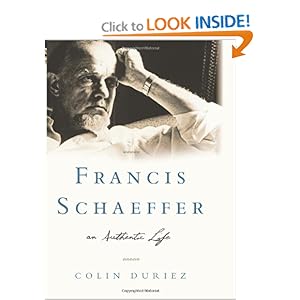
Colin Duriez's biography certainly did not disappoint me on that quest to know Francis Schaeffer better.
Duriez, who bases his "Authentic Life" on voluminous personal interviews (including an interview with Schaeffer himself added as an appendix) does an admirable job in tying together first-hand witnesses, written sources, letters, and the author's own personal experiences at L'Abri in Schaeffer's presence.
Duriez traces the unassuming young man from his rural Pennsylvania upbringing, through his fundamentalist early years in the pastoral ministry, into his European study excursion, and ultimately to his founding of L'Abri and corresponding meteoric rise in international prominence, driven by his writings and film production.
Thankfully, someone has done a full-length biography of this prophetic pastor, and cultural guru before the generation of living witnesses to his ministry thins and ultimately dies out. This book combines the authoritative force of a well-researched documentary, with the personal ethos of a student of Fran who knew him personally.
By the time the author traces Francis Schaeffer's life to his demise at the mercy of cancer in 1984, the reader feels that he too--along with the whole evangelical community--has lost an important voice for truth.
Thankfully, Schaeffer's writings live on, continuing to influence generations still today. This biography would serve as an excellent companion for those considering spending some time in Schaeffer's mind though his writings and films. Colin Duriez's book will doubtlessly last as a helpful companion to understanding the life and mind of the author of these epochal works.
Matthew Everhard is the Senior Pastor of Faith Evangelical Presbyterian Church in Brooksville, Florida.
Saturday, June 23, 2012
Reflections on the Jerry Sandusky verdict
By Pastor Matt Ellis

Did the jury get it right? Or, as the case proceeds through the appeals process (which almost certainly is a given), will it become apparent that the witnesses were lying? Who knows?
But, there is one person who most certainly knows - Jerry Sandusky. As the verdict was read, Sandusky showed little emotion. Yet, inside his mind and heart, he knew the truth. If he is truly guilty, there was never an acknowledgment of it.
This is human nature.
Adam and Eve would not volunteer a confession until God confronted them (Genesis 3).
Sarah could not acknowledge the fact that she laughed at a promise given by the Lord even when confronted (Genesis 18:9-15).
David refused to acknowledge an adulterous affair, murder and deception until the prophet Nathan confronted him (2 Samuel 12:1-15).
Annanias and Saphirra would not volunteer the truth to the Apostle Peter (Acts 5:1-11).
This is human nature ... or rather an evidence of the sin nature. Valuing self-protection and comfort more than "truth," the sin nature lies and refuses to acknowledge truth.
And, depending upon the nature of the offense, some folks (who have an active conscience) will withhold the truth to their own harm. They will live with guilt the rest of their lives. If they don't shut their conscience down completely ("sear it" - 1 Timothy 4:2), they will begin to experience problems with their health, relationships, etc.
In his commentary on the book of Ephesians, John MacArthur recounts the following story:
According to an ancient Greek story, a Spartan youth stole a fox but then inadvertently came upon the man from whom he had stolen it. To keep his theft from being discovered, the boy stuck the fox inside his clothes and stood without moving a muscle while the frightened fox tore out his vital organs. Even at the cost of his own painful death he would not own up to his wrong."
It is a godly and courageous person, indeed, who will own up to what they have done. Why is it courageous? Because it is rarely if ever easy. In fact, it may be the hardest and most frightening thing someone will ever do ... and in confessing, there may be consequences.
But there is so much on the line! Why?
Because if the person is saved, God will bring discipline into that person's life until they make it right (Hebrews 12:5-11).
And if discipline does not come in this life, it shows that someone is not God's child. Thus, they will hear the Lord say on the Day of Judgment: "I never knew you, depart from me..." (Matthew 7:22-23). The place to which these men and women are sent is a place of intense anguish (Matthew 13:41-42; Revelation 20:11-15). And it will be forever (Matthew 25:46). Horrid thought!!!
This second possibility shows that a desire to protect oneself from truth and consequences in this life may reveal that there are infinitely greater consequences in the life to come.
It's not worth it! Just mediate on the promise and joy of experiencing the truth of this verse, of being right with God:
"If we confess our sins, he is faithful and just to forgive us our sins and to cleanse us from all unrighteousness." (1 John 1:9).
Being right with God and enjoying Him is worth whatever cost you may have to pay to get it!
Matt Ellis is Senior Pastor at the First Baptist Church of Brooksville, Florida. Follow him on Twitter @mattellis1997 or on Facebook at www.facebook.com/mattellis1997.
Subscribe to:
Posts (Atom)